


Table of Contents
- What Makes a Truly Sustainable Home Decor Brand in 2026
- 1. The Spotted Quoll: Organic Linen and Hemp Cushions Made in Tasmania
- 2. Choosing Eco-Friendly Homewares Australia: What to Look For
- 3. How to Identify Greenwashing in Furniture and Decor
- 4. Sustainable Interior Design Tips for a Low-Impact Home
- 5. Indoor Air Quality and VOC-Free Decor for Healthier Living
- 6. Budget-Friendly Sustainable Sourcing and End-of-Life Disposal
- Conclusion: Building a Conscious Home in 2026
- Frequently Asked Questions
Last Updated: October 3, 2026
What Makes a Truly Sustainable Home Decor Brand in 2026
Sustainable home decor means furnishing a home with pieces made from renewable or recycled materials, produced ethically, and designed to last for years rather than seasons. In practice, the label gets stretched so thin that "eco-friendly" on a swing tag often means nothing.
That's the tension running through this guide: the gap between what brands say and what they can prove. The Australian Competition and Consumer Commission's guidance on environmental claims is blunt on this point: a business must be able to substantiate every green claim it makes.
Vetting Criteria: Certifications and Material Transparency
A trustworthy brand names its materials, its factory and its certification body. Look for:
- Named fibres: "organic linen," "certified organic wool," "hemp" rather than "natural blend"
- Traceable origin: where the fibre was grown and where the piece was sewn
- Recognised certification: a third-party logo with a registration number you can check
1. The Spotted Quoll: Organic Linen and Hemp Cushions Made in Tasmania
The Spotted Quoll is our own studio, and we'll be upfront about that. We design and make everything in Tasmania, from print to final stitch, using organic linen, hemp, cotton canvas and certified organic wool felt.
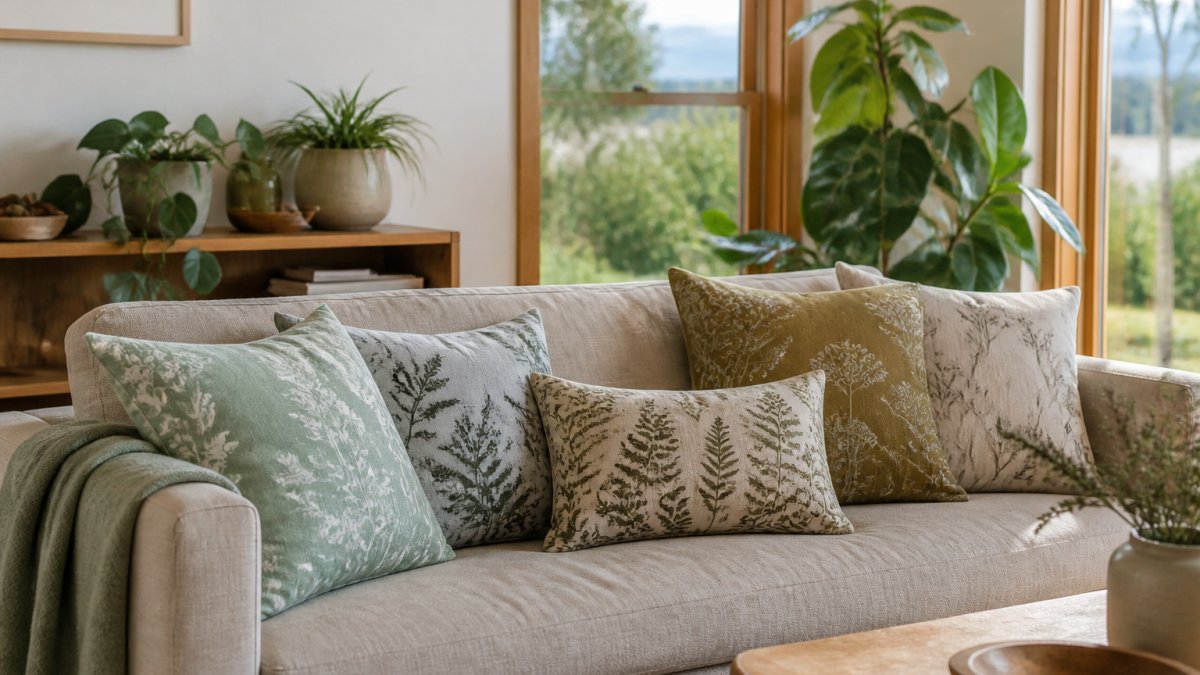
The Seed Pods Cushion ($59) is our most accessible entry point: heavyweight 220gsm organic linen and hemp with a forest-floor print, French seam and envelope opening.
For something warmer, the Cradle Mountain Organic Wool Felt Cushion ($99) uses 100% certified organic wool felt with a hand-finished blanket stitch.
A common mistake is treating cushions as disposable. Ours are built to be re-covered, re-stuffed and kept.
2. Choosing Eco-Friendly Homewares Australia: What to Look For
Eco-friendly homewares in Australia means prioritising local production, natural fibres and materials that don't off-gas. The shorter the supply chain, the easier it is to verify, but 'natural' and 'local' are starting points, not proof. The real work is knowing which certifications mean something.
Natural Fibres, Solid Wood, and Renewable Resources
Not all "natural" materials are equal. Here's how the main options compare:
| Material | Renewable? | Biodegradable? | Best For |
|---|---|---|---|
| Organic linen | Yes (flax) | Yes | Cushions, throws, bedding |
| Hemp | Yes, fast-growing | Yes | Durable covers, upholstery |
| Certified organic wool | Yes | Yes | Felt, blankets, insulation |
| Solid timber (FSC) | Yes, if managed | Yes | Furniture frames |
| Recycled cotton canvas | Partly | Yes | Backing, structural panels |
Flax and hemp need little irrigation and few pesticides compared with conventional cotton. Certified organic wool is traceable to the farm, and responsibly managed solid wood stores carbon for the life of the piece.
Two trade-offs worth naming honestly:
- Hemp is more durable but coarser. It softens with washing, but a hemp-forward cover feels different to linen on day one.
- Recycled cotton canvas is only partly renewable. It diverts waste from landfill, but it still relies on cotton inputs and is often blended, which complicates end-of-life composting.
Certifications That Actually Mean Something
A logo on a swing tag is not evidence; a certification with a registration number you can look up is. The schemes most commonly seen on home textiles and furniture:
- GOTS (Global Organic Textile Standard), covers the full textile supply chain, from organic fibre to processing and social criteria. "Organic cotton" without GOTS or an equivalent is unverified.
- GOLS (Global Organic Latex Standard), the equivalent scheme for organic latex fill.
- OEKO-TEX Standard 100, tests the finished product for harmful substances. It doesn't certify the fibre as organic, but signals safe dyes and finishes.
How to Verify a Claim in Under Two Minutes
- Find the certification body's name and licence or registration number on the product page or swing tag.
- Search the certification body's public database for that number.
- Check the scope. A GOTS certificate covers specific products from a specific facility, not everything the brand sells.
- Cross-check the fibre claim against the certificate. "Made with organic cotton" and "GOTS-certified" are not the same statement.
- If there's no number, there's no certification. Move on.
Questions to Ask Before You Buy
A maker who can answer these clearly is usually worth buying from:
- What is the full fibre composition, including trims and thread?
- Where was the fibre grown, and where was the piece sewn?
- Which certification body issued the certificate, and what's the registration number?
Vague answers are themselves a data point.
3. How to Identify Greenwashing in Furniture and Decor
Greenwashing is when a brand exaggerates or invents environmental credentials to sell a product. It's widespread and getting harder to spot as the language becomes more sophisticated.
Vague Claims vs Verifiable Certifications
The test is simple: can the claim be checked by someone other than the brand?
- Vague: "planet-friendly," "eco-conscious," "made with care"
- Verifiable: "printed on GOTS-certified organic cotton," "made in a studio in Tasmania"
The OECD's guidance on environmental claims notes that unqualified claims without evidence mislead consumers and distort competition. If a brand won't name its certification body, assume there isn't one.
4. Sustainable Interior Design Tips for a Low-Impact Home
Sustainable interior design is about buying less, choosing better and keeping pieces in use longer. The most sustainable cushion is the one you already own. Principles that move the needle:
Nights Garden Cushions - Flat Pack →
- Buy for ten years, not one season. Timeless prints and neutral bases outlast trend-driven designs.
- Mix and match rather than replace. Our cushions are designed to pair across collections, so you can refresh a room without buying a whole new set.
- Repair before replacing. Re-stuff a flat insert, re-cover a worn cushion, re-oil a timber surface.
5. Indoor Air Quality and VOC-Free Decor for Healthier Living
VOC-free decor matters because volatile organic compounds from synthetic finishes, adhesives and cheap foams can affect indoor air quality for months after purchase. Natural fibre textiles and solid, untreated timber are the low-risk choices.
Where VOCs hide in home decor:
- Synthetic foam inserts and cheap polyfill
- Lacquers and solvent-based sealants on furniture
- Adhesive-backed wall coverings and vinyl prints
Natural linen, hemp, cotton canvas and wool felt don't carry these concerns, and they breathe, helping regulate humidity. If anyone in your household has sensitivities, prioritise this category.
6. Budget-Friendly Sustainable Sourcing and End-of-Life Disposal
Most sustainable decor guides assume a renovation budget. This section doesn't. It covers sourcing well on a modest spend, and what to do with a piece at the end of its life.
Sourcing Well Without a Big Spend
The cheapest sustainable purchase is the one you don't make. Otherwise, maximise cost-per-year-of-use, not sticker price.
- Buy one anchor piece, not a set. A single well-made cushion or throw lifts a room more than four cheap ones and sets the palette you build on later.
- Start at a maker's entry price point. Our Seed Pods Cushion at $59 lets you test the construction, print quality and fibre before committing to a larger piece.
- Buy covers flat packed, source inserts locally. Inserts are bulky and expensive to freight; a local feather or wool insert cuts cost and emissions.
A useful rule of thumb: divide the price by the number of years you realistically expect to keep the piece. A $99 cushion kept for a decade costs about $10 a year. A $25 cushion replaced every eighteen months costs more, and sends six times the waste to landfill.
End-of-Life: What Actually Happens to Decor When You're Done With It
This is the gap in nearly every ranking guide: sustainability content focuses almost entirely on purchase. But a cushion, throw or timber frame that ends up in general waste undoes much of the benefit of buying it well. How the main decor materials behave at end of life:
| Material | Best end-of-life route | Watch out for |
|---|---|---|
| Organic linen / hemp cover | Home compost or textile recycling once trims are removed | Invisible zips, synthetic labels and polyester thread |
| Cotton canvas backing | Commercial composting or textile recycling | Blended fibres can't be separated |
| Certified organic wool felt | Re-purpose as padding, or compost via a wool-accepting service | Moth treatment residues |
| Feather insert | Re-cover and reuse indefinitely; compost feathers if a service accepts them | Synthetic ticking |
| Solid timber frame | Repair, re-oil, donate, or take to a timber recycler | Solvent-based lacquers and glues |
| Synthetic foam or polyfill | General waste in most areas, avoid where possible | No mainstream recycling pathway |
A few practical mechanisms worth knowing:
- Remove the hardware first. Zips, metal eyelets and synthetic care labels must come off before a natural-fibre cover can be composted. A seam ripper and five minutes is usually all it takes.
- Check your local council's textile and organics rules. Kerbside organics collection varies widely, and textiles are accepted in some council areas and excluded in others. Your council's waste guide tells you which bin a cover belongs in.
- Use textile take-back schemes where they exist. Many apparel and homeware retailers run in-store collection for worn textiles, sorted for re-use or fibre recycling. Ask at the counter.
A Simple End-of-Life Checklist
Before any decor item leaves your home, run through this:
- Can it be repaired or re-covered?
- Can it be donated in its current condition?
- Can the natural-fibre components be separated and composted?
- Is there a textile or timber take-back scheme nearby?
- Only then, general waste.
Working through those five questions takes two minutes and keeps a surprising amount of material out of landfill.
Conclusion: Building a Conscious Home in 2026
The hardest part of building a conscious home isn't finding sustainable options, it's cutting through the claims to find makers who can prove what they say. Ask for the fibre, the origin and the certification.
That's the standard we hold ourselves to at The Spotted Quoll.
Get started with The Spotted Quoll and furnish your space with pieces that are kind to you and the earth.
Frequently Asked Questions
What defines a truly sustainable home decor brand?
A genuinely sustainable home decor brand combines material transparency, ethical manufacturing, and low environmental impact across the product lifecycle. Look for natural fibres like organic linen, hemp, and certified organic wool, plus clear information about where and how items are made. Brands that publish details on waste reduction, supply chain ethics, and circular economy practices, rather than vague eco-friendly claims, are more trustworthy. Australian-made pieces from small studios often provide this transparency more readily than mass-produced imports.
How can I identify greenwashing in home decor?
Greenwashing appears as vague claims like 'eco-friendly' without specifics, unverified certifications, or imagery of nature that has no bearing on production. Ask: Does the brand name its materials and their origins? Can it prove ethical manufacturing with certifications or studio transparency? Does it disclose waste reduction practices? A brand claiming sustainability should be able to explain its supply chain ethics and material transparency. If the only evidence is leafy graphics and buzzwords, treat the claim with caution.
Are there Australian-made sustainable decor options?
Yes. Australian-made sustainable decor options include small studios producing cushions, textiles, and homewares from natural fibres and recycled content. Buying locally reduces the carbon footprint of shipping and supports regional craftsmanship. Look for brands that design and manufacture in Australia, use organic or renewable resources, and offer material transparency. Locally made pieces also tend to have shorter supply chains, making ethical manufacturing easier to verify.
What certifications should I look for when buying sustainable homewares?
Look for certifications that verify specific claims: organic content certification for natural fibres, fair trade certification for ethical manufacturing, and carbon neutral or climate neutral accreditation for emissions. For Australian buyers, check whether the brand participates in recognised textile recycling or product stewardship schemes. Certifications should be named and verifiable, not just mentioned as a logo. If a brand lists no certifications, ask directly about its supply chain ethics and material sourcing.
How does choosing sustainable decor impact my home's carbon footprint?
Sustainable decor reduces your home's carbon footprint by lowering embodied carbon, the emissions tied to making and shipping products. Locally made items cut transport emissions, while natural fibres like organic linen and hemp require less energy than synthetic alternatives. Durable design extends product life, reducing waste. Choosing upcycled or recycled content further shrinks environmental impact. The biggest gains come from buying fewer, better pieces that last years rather than replacing trend-driven decor each season.