

Table of Contents
- Australian Made Fashion vs Fast Fashion: The Comparison Table
- What Separates Slow Fashion From Disposable Trends
- The Cost Per Wear Calculation That Changes the Decision
- How to Spot Greenwashing in Fashion
- Building a Sustainable Capsule Wardrobe With Locally Made Pieces
- Caring, Repairing and Keeping Australian Made Fashion in Rotation
- Conclusion
- Frequently Asked Questions
Last Updated: October 1, 2026
Australian Made Fashion vs Fast Fashion: The Comparison Table
Australian made fashion is clothing designed, cut and sewn locally under Australian workplace law, while fast fashion is mass-produced offshore for rapid turnover and low prices. This guide from The Spotted Quoll compares both on cost, longevity and ethics. The gap between them shows up fastest in your wardrobe, not your receipt.
| Factor | Australian Made Fashion | Fast Fashion |
|---|---|---|
| Upfront price | Higher per garment | Lower per garment |
| Cost per wear | Falls with every wear | Rises as the item fails |
| Fabric | Natural fibres, often organic | Mostly synthetic blends |
| Traceability | Maker and studio known | Opaque offshore supply chain |
| Lifespan | Years with basic care | A season, sometimes less |
| Repairs | Simple, worth doing | Rarely economical |
The Australian Fashion Council tracks how clothing is made and sold here, and the picture is not flattering.
What Separates Slow Fashion From Disposable Trends
The core difference is design intent. Slow fashion is built to be worn for years, while disposable trends are built to be replaced.
Where Fast Fashion Saves Money and Where It Costs You
Fast fashion genuinely saves money at the register. A cheap top costs less today than a well-made one, and that is a real advantage for tight budgets.
The Cost Per Wear Calculation That Changes the Decision
Cost per wear is the purchase price divided by the number of times you actually wear the garment. It is the single most useful number in this whole comparison.
Run the sum before you buy:
- Note the price.
- Estimate wears per year, honestly.
- Multiply by the years you expect it to last.
- Divide price by total wears.
How to Spot Greenwashing in Fashion
Greenwashing is marketing that implies environmental or ethical standards a garment does not actually meet. It is common, and it is designed to be hard to check. The reason it works is that most shoppers have no way to tell a verified claim from a decorative one, so the label does the persuading.
The certifications worth checking
The practical fix is to stop reading adjectives and start reading certifications. A certification is a claim someone else has verified against a published standard. A slogan is not. The ones you will actually encounter on locally made garments include:
- Ethical Clothing Australia, an accreditation for local cut, make and trim operations that verifies workers are paid correctly and treated lawfully. It is the most relevant scheme for a garment that is genuinely cut and sewn here, because it audits the local supply chain rather than an offshore one.
- Global Organic Textile Standard (GOTS), covers organic fibre content and processing, including chemical and wastewater rules, across the whole textile chain.
- OEKO-TEX Standard 100, tests finished textiles for harmful substances. It says nothing about labour conditions, so treat it as a fibre-safety claim only.
- B Corp certification, a whole-of-business social and environmental assessment. Useful context, but it is not a garment-level guarantee.
The three questions that cut through it
Ask, and expect a specific answer to each:
- Which specific fibre is this, and what percentage? "Natural blend" is not an answer. "55% linen, 45% organic cotton" is.
- Where was it cut and sewn? A studio or factory name beats a country name, and a country name beats silence.
- Which certification or standard backs the claim, and who audits it?
If a brand cannot answer all three, treat the green claim as decoration. If it answers two and dodges the third, that dodge is the answer.
Why this matters more for local claims
A "made here" claim is itself a representation, and it is one of the most commonly overstated. A garment can be designed here, printed here, or finished here and still be cut and sewn offshore. If the local story is the reason you are paying more, the certification is the thing that makes the story checkable rather than aspirational.
Building a Sustainable Capsule Wardrobe With Locally Made Pieces
A sustainable capsule wardrobe is a small set of versatile garments that mix together, suit your climate, and last more than one season. Fewer, better pieces beat a full rail of maybes. But "fewer, better" only works if you understand why the better piece costs more in the first place, otherwise the upfront price wins the argument every time.
Why a locally made garment costs more
The price gap is not markup. It is the cost structure. When a garment is cut and sewn locally, the largest line item is the wage of the person who made it, paid under Australian workplace law, in an Australian studio, with Australian overheads. Offshore mass production spreads that same labour across a much lower wage base and far higher volumes, which is why the register price lands so much lower.
Linen Mini Pleat Top - Flock Together →
The hidden costs on the cheap side
The cheap garment is not actually cheaper. It is just billed differently. The costs you do not see at the register include:
- Replacement frequency, the same basic item bought several times over a few years.
- Cost per wear, a low price divided by four wears is a high number.
- Repair economics, thin seams and poor fabric rarely justify the cost of fixing them, so the garment becomes waste instead.
- Your time, sourcing, re-buying and replacing is unpaid labour you do not count.
Start with fabric, then build the base
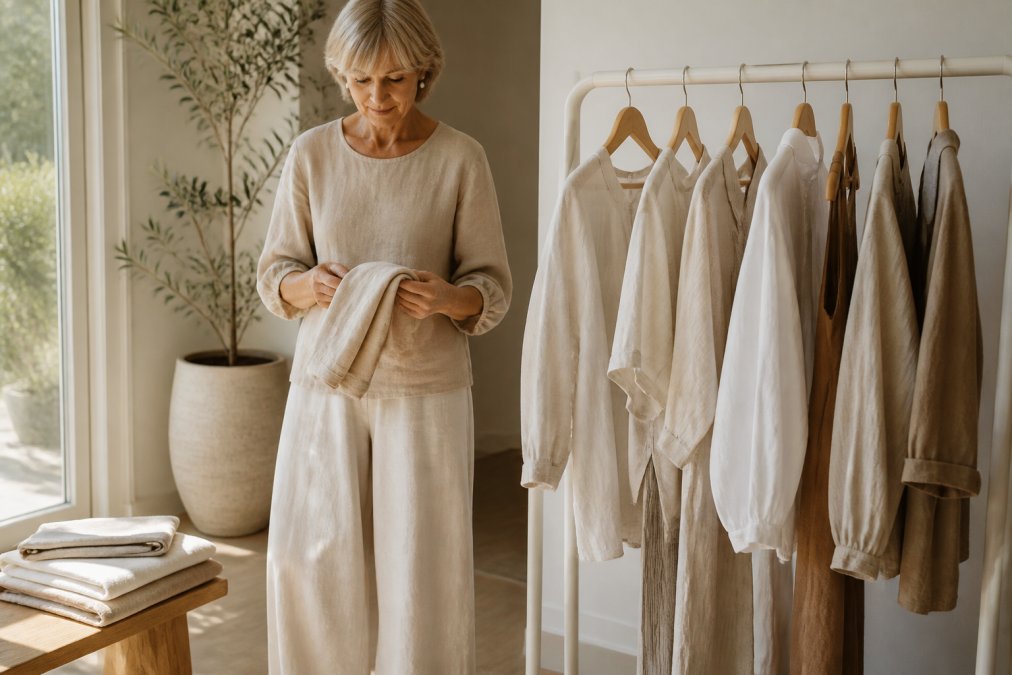
Start with fabric. Natural fibres breathe in heat and hold up to repeated washing, which matters in a hot climate. Linen and organic cotton are the workhorses here.
- One relaxed linen top you can dress up or down
- One pair of easy wide-leg pants
- One dress that works for work and weekends
- One layering piece for cooler months
- One pair of shoes that suits most outfits
The test before you buy
Run each candidate piece through the same three checks:
- Fibre, can you name it and its percentage?
- Origin, can you name where it was cut and sewn?
- Cost per wear, does the price divided by realistic wears beat the cheap alternative you would otherwise rebuy?
If a piece fails any of the three, it is not a capsule piece. It is a future donation.
Caring, Repairing and Keeping Australian Made Fashion in Rotation
Garment longevity is mostly a care question, and it is where locally made pieces pull ahead. Better fabric and construction survive the washing machine; thin fast-fashion blends usually do not.
The rules are simple:
- Wash cold, on a gentle cycle, inside a laundry bag
- Use a phosphate-free detergent
- Hang inside out to dry, out of direct sun
- Iron on the reverse if needed
- Repair loose seams and missing buttons early, before they spread
Conclusion
The real challenge is not finding sustainable clothing, it is finding pieces you will still reach for in three years. Cost per wear, fibre content and transparency separate genuine Australian made fashion from greenwashed marketing, and those three checks take minutes.
Frequently Asked Questions
What is the difference between fast fashion and slow fashion?
Fast fashion pushes new styles into stores within weeks, using synthetic fibres and mass production to keep prices low, so garments are worn a handful of times before they lose shape or go out of favour. Slow fashion works on the opposite model: smaller runs, natural fibres, and designs made to stay in rotation for years. The practical difference shows up in your wardrobe, where a slow piece gets worn across seasons while a fast piece often sits unworn after one summer.
Why is Australian made fashion considered more sustainable?
Making garments locally shortens the supply chain, which means fewer transport emissions and clearer visibility over who cut and sewed each piece. Local production also sits under Australian workplace and consumer law, so labour conditions and labelling claims can be checked rather than taken on trust. When a studio like The Spotted Quoll makes pieces in Tasmania from organic linen, the fibre choice and the manufacturing location both reduce the environmental load compared with an imported synthetic garment.
How does fast fashion impact the environment in this country?
Clothing that arrives cheaply is usually made from synthetic fibres, which shed microplastics in the wash and take centuries to break down in landfill. Australians donate heavily to op shops, but only a fraction of that volume is resold, so a large share of donated clothing is exported or sent to waste. Choosing natural fibres and keeping garments in use longer reduces both the volume sent to landfill and the carbon footprint tied to producing replacements.
What is the cost per wear concept in fashion?
Cost per wear is the purchase price divided by the number of times you actually wear the item. A $25 top worn three times costs about $8.33 per wear, while a $198 organic linen top worn 60 times works out to roughly $3.30 per wear. The calculation only works if the garment survives the wears, which is why fabric weight, stitching quality and care instructions matter as much as the price tag.
How can I identify genuine Australian made clothing?
Look for the triangular Australian Made, Australian Grown kangaroo logo, which is used under a certification scheme rather than self-declared. The term 'Australian made' has a legal definition: the garment must be substantially transformed here, not just finished or packaged locally. If a label says 'designed in Australia' but not 'made in Australia', the sewing happened offshore. Brands that manufacture locally can usually tell you which studio made the piece and in what quantity.