


Table of Contents
- Start With What You Already Own
- Sustainable Home Decor Australia: Shop Second-Hand and Local First
- Capsule Home Decor Ideas: Build a Curated Core Collection
- Eco-Friendly Interior Design Tips: Natural Fibres and Textural Layering
- Rearrange, Repurpose, and Refresh Without Spending
- Invest in Pieces That Last: Maintenance and Longevity
- Common Mistakes That Undermine a Conscious Home
- Conclusion: Style With Intention, Not Excess
- Frequently Asked Questions
Last Updated: October 3, 2026
Start With What You Already Own
Styling a conscious home on a budget starts with the pieces already in your space.
Most people underestimate what they already have. A common mistake is buying new decor before checking the cupboard.
Try this simple process:
- Empty one shelf or surface at a time
- Group similar items together
- Set aside anything broken or unused
- Rehome what you no longer need
- Style only what remains
At The Spotted Quoll, we design homewares meant to sit alongside what you already own, not replace it. A single well-made cushion can shift the feel of a whole room.
Sustainable Home Decor Australia: Shop Second-Hand and Local First
Sustainable home decor in Australia often means shopping second-hand and local before looking anywhere else. Pre-loved pieces carry history, cost less, and keep usable items out of landfill. Local makers cut transport emissions and support small studios.
Where you buy matters as much as what you buy. The Australian Government's recycling and waste guidance explains how reusing goods reduces pressure on landfill.
Where to Look for Thrifted and Pre-Loved Pieces
- Op shops and charity stores for ceramics, linen, and timber
- Facebook Marketplace and Gumtree for furniture
- Estate sales for older, well-built pieces
Check condition before you commit. Loose joints, deep cracks, and water stains rarely improve with time.
Capsule Home Decor Ideas: Build a Curated Core Collection
A capsule home decor approach means choosing a small set of versatile pieces that work together across every room. Instead of chasing trends, you build a core collection you can rotate, restyle, and keep for years.
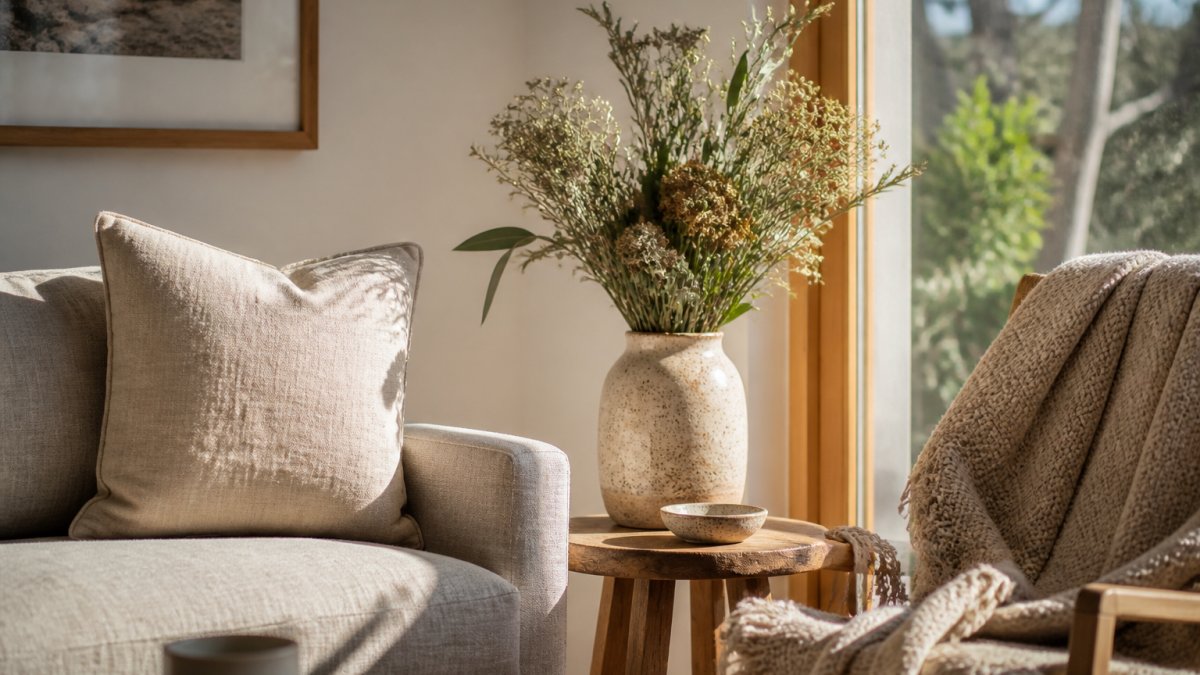
Think of it like a wardrobe. Fewer, better pieces beat a crowded shelf every time, and the same logic that stops you buying a fourth black t-shirt should stop you buying a fourth scented candle.
The Five-Piece Framework for a Capsule Home
- One anchor textile such as a wool throw or linen cushion, this sets the dominant tone
- One natural material piece like timber, stone, or unglazed ceramic, this grounds the palette
- One living element such as a plant or dried arrangement, this adds movement and softens hard edges
- One handmade object with a story behind it, this is the piece guests ask about
- One neutral base in a calm tone, this is the surface or floor layer everything else sits on
The framework works because each piece has a job. The anchor textile carries colour and softness. The natural material piece adds weight so the room does not float. The living element breaks up straight lines. The handmade object introduces irregularity, which is what stops a styled room looking like a showroom. The neutral base holds it all together.
How to Choose Pieces That Actually Work Together
Most people get this wrong by buying five things they love individually and then wondering why the room feels disjointed. The fix is to choose against a constraint, not a mood board.
- Pick two or three tones and stay inside them. Warm neutrals, cool neutrals, or earth tones. Mixing all three is what makes a capsule collapse into clutter.
- Vary scale deliberately. A large cushion next to a small vase reads as considered. Three objects of the same size read as a shelf.
- Repeat one material across the room. If timber appears in the side table, let it appear again in a frame or a bowl. Repetition is what makes a capsule feel intentional rather than sparse.
Rotating a Capsule Instead of Replacing It
A capsule is not static. The same five pieces can move between rooms, and the same cushion can anchor a bed one month and a reading chair the next.
A simple rotation pattern:
- Move the anchor textile to a different room each season
- Swap the handmade object between the entry, the living room, and a bedside table
- Repot or reposition the living element rather than replacing it
Storage matters here. A capsule only works if the pieces you are not using are put away properly, folded textiles in a dry cupboard, ceramics wrapped, timber out of damp.
Our Nights Garden Cushions - Flat Pack fit this framework well.

Eco-Friendly Interior Design Tips: Natural Fibres and Textural Layering
Eco-friendly interior design tips usually come down to two things: natural fibres and textural layering. Linen, wool, hemp, and cotton breathe better than synthetic options and age with character rather than falling apart.
Texture does the heavy lifting in a neutral room. Without it, a calm palette can read as flat.
Layer in this order:
- Start with a base textile on the floor or sofa
- Add a mid-weight layer such as a throw
- Finish with a small accent like a cushion or tray
A Macrame Plant Hanger adds texture at eye level and costs little. Hanging greenery also frees up floor space.

Rearrange, Repurpose, and Refresh Without Spending
Rearranging what you own is the fastest free refresh available. Move the sofa off the wall. Swap art between rooms. Turn a bedroom chair into a hallway console. Small shifts change how a space feels.
Nights Garden Cushions - Flat Pack →
Space planning matters more than new purchases. A room with clear walkways feels larger and calmer.
Try these swaps:
- Rotate cushions and throws between rooms
- Move a rug to a different zone
- Repurpose jars, crates, and baskets for storage
Invest in Pieces That Last: Maintenance and Longevity
Pieces that last are the real budget saver. A well-made item bought once usually costs less over ten years than three cheap replacements, but only if you maintain it. This is the part most budget decor guides skip, because it does not photograph well. It is also the part that separates a conscious home from a cheap one.
The Cost-Per-Year Way of Thinking
Instead of asking what something costs today, ask what it costs per year of use. A cushion cover that lasts two years and a cushion cover that lasts ten are not competing on price, they are competing on cost per year, and the longer-lived one usually wins even when it costs more upfront.
This reframe changes what you buy. It pushes you toward natural fibres that age with character rather than synthetics that pill and fade, and toward solid construction over glued joints. It also makes repair the default response to damage, rather than replacement.
Care Basics for Natural Materials
- Wash linen and cotton on a cool, gentle cycle, and line dry in shade rather than tumble drying
- Air wool rather than washing it often, wool self-cleans to a degree, and frequent washing shortens its life
- Keep timber out of direct sun and away from heaters, which dry and crack it
Repair Before You Replace
Most decor items fail in predictable ways, and most of those failures are fixable.
- A split seam on a cushion is a ten-minute hand stitch, not a reason to buy a new cover
- A wobbly chair leg is usually a loose screw or a dried glue joint, both repairable
- A faded timber surface can be re-oiled rather than replaced
A common pattern is that people replace items at the first sign of wear, when a repair or a change of role would have extended the item by years. Keeping a small repair kit, needle, thread in two neutral tones, wood glue, fine sandpaper, a tin of oil, makes the repair option the easy one.
End-of-Life Decisions
Eventually, some pieces genuinely reach the end. The conscious move is to plan for that rather than bin it.
- Natural fibres like linen, wool, hemp, and cotton can often be composted or used as rags
- Timber can be repurposed, given away, or taken to a council transfer station for appropriate processing
- Ceramics that are broken beyond use should be wrapped and disposed of carefully, not placed in recycling
The Australian Government's recycling and waste guidance is a useful reference for what can and cannot be reused or recycled in your area, since rules vary between councils.
A Glazed Earth Hanging Planter - Angus and Celeste shows how good design reduces upkeep.

Common Mistakes That Undermine a Conscious Home
The biggest mistake is treating conscious styling as a shopping list. Buying more "sustainable" items to fix a cluttered room misses the point entirely.
Other common traps:
- Chasing trends instead of building a core collection
- Mixing too many colours at once
- Ignoring scale, so small pieces get lost
The psychology of space matters here. Clutter raises stress, while open surfaces and clear sightlines help a room feel calm.
For a small handmade touch, our Wooden Houses - Tasmanian Timbers are crafted from timbers like Huon Pine and Blackwood.
Conclusion: Style With Intention, Not Excess
Building a home that feels considered takes time, and the pressure to keep buying makes it harder. The Spotted Quoll makes homewares designed and made in Tasmania from natural fibres, with exclusive nature-inspired prints built to last beyond a single season. Explore the range, choose a few pieces you genuinely love, and style with intention rather than excess.
Frequently Asked Questions
What is the 3-5-7 rule in decorating?
The 3-5-7 rule is a styling guideline for arranging accessories in odd-numbered groups: three small items, five medium items, and seven larger items. Odd numbers create visual interest because the eye cannot pair them symmetrically. For a conscious home, apply this rule using pieces you already own or have sourced second-hand. Group a cluster of three ceramic pots, five books, and seven dried stems on a shelf. The rule helps you avoid clutter while giving each surface a deliberate focal point.
How do I build a capsule home collection?
A capsule home collection works like a capsule wardrobe: a small set of versatile, high-quality pieces that mix and match across rooms and seasons. Start with a neutral base (linen, cotton, wool, timber) and add two or three accent colours. Choose items that serve more than one purpose, such as a cushion that works on a bed or sofa, or a planter that suits indoor and outdoor use. Replace worn items only when necessary, and prioritise natural materials that age well.
What are the benefits of choosing natural fibres for home decor?
Natural fibres like linen, hemp, cotton, and wool breathe better than synthetic alternatives, which helps regulate room temperature and reduces moisture buildup. They also age gracefully, developing character rather than pilling or cracking. Many natural fibres are biodegradable at end of life, unlike polyester or acrylic. When you choose organic linen or hemp cushion covers, for example, you support lower-impact farming and avoid the microplastics that synthetic textiles shed during washing.
How to style a home using pre-loved or vintage items?
Start by decluttering what you own, then identify gaps in your styling rather than shopping for new. Search op shops, Facebook Marketplace, and local salvage yards for solid timber furniture, ceramic vases, and framed art. Mix pre-loved pieces with a few new items to avoid a dated look. Clean and repair items before styling them. Group vintage finds by colour or material so they feel intentional rather than random. A single second-hand timber stool can anchor a reading nook for under $20.
A calm, well-styled home rarely comes from a bigger budget. It comes from buying less and choosing better. The Spotted Quoll offers natural fibre homewares, exclusive nature-inspired prints, and small-batch pieces made in Tasmania. Get started with The Spotted Quoll and build a home that lasts.