


Table of Contents
- Start With a Plan: What Eco-Friendly Home Decor for Small Apartments Actually Requires
- Step 1: Choose Sustainable Materials That Suit a Rental
- Step 2: Solve Small Space Storage Solutions Without Drilling
- Step 3: Add Natural Fibre Home Accessories and Low-Maintenance Greenery
- Step 4: Find Ethical Home Decor Brands Australia Shoppers Can Trust
- Two Things Most Guides Skip: Indoor Air Quality and What Happens at Disposal
- Common Mistakes That Undo Eco-Friendly Home Decor for Small Apartments
- Frequently Asked Questions
Last Updated: October 2, 2026
Start With a Plan: What Eco-Friendly Home Decor for Small Apartments Actually Requires
Eco-friendly home decor for small apartments means furnishing a compact rental with low-impact materials, flexible pieces and minimal waste, without drilling or losing floor space. At The Spotted Quoll, we make homewares in Tasmania from natural fibres, so we see how much a considered plan matters before you buy.
Small apartments punish impulse buys: one wrong purchase eats a shelf, blocks a walkway, or gets tossed at the next move. Plan first, shop second.
Here is how to choose, store and style eco-friendly pieces that fit a rental and survive a move.
The three questions to ask before you buy anything
Ask these before you spend a cent:
- Can I move it alone? If not, it will not survive your next lease.
- What is it made from? Natural fibres, reclaimed wood and bamboo age well. Mixed plastics usually do not.
- Where does it go when I am done? If the answer is "the bin", keep looking.
That third question changes what you buy.
What you need before you start
Gather these first:
- A tape measure, so you buy to your actual space
- A rough budget, split into needs and wants
- A list of your lease rules on wall fixings
- Two or three inspiration photos, no more
A clear plan beats a big one.
Step 1: Choose Sustainable Materials That Suit a Rental
Sustainable materials are grown, harvested or reclaimed with low environmental impact and fewer chemical finishes. For renters, the best are also light, durable and easy to move, a material that fails on any of those becomes waste at the next lease.
The more useful question is life-cycle impact: where a material comes from, how it was processed, how long it lasts, and what happens at the end.
Reading a material by its life cycle, not its label
Bamboo. A fast-growing grass that regenerates from the same root system, so it needs no replanting.
Cork. Harvested from cork oak bark without felling the tree; the bark regrows in roughly nine years.
Reclaimed wood. Timber diverted from demolition, old furniture or offcuts.
Jute and seagrass. Plant fibres woven into rugs and baskets.
Virgin plastic and mixed composites. The problem is the pattern: short-lived, hard to repair, rarely recycled.
Here is how the main options compare for a small rental:
| Material | Best For | Life-cycle strength | Watch Out For |
|---|---|---|---|
| Bamboo | Trays, plant stands, small boards | Fast regrowth, no replanting | Adhesives; warps if left wet |
| Cork | Coasters, boards, floor tiles | Bark regrows, tree survives | Fades in direct sun |
| Reclaimed wood | Shelves, side tables | Reuses already-felled timber | Heavier to move |
| Organic linen and hemp | Cushions, throws | Low water and pesticide use | Creases easily |
| Wool | Throws, rug underlays | Durable, naturally flame-resistant | Needs careful washing |
| Jute and seagrass | Rugs, baskets | Biodegradable, inexpensive | Sheds; degrades in damp |
| Virgin plastic | Utility items only | Long life if well made | Rarely recycled; short-lived versions become waste |
The indoor air quality angle most guides miss
Small apartments have less air to dilute fumes, so material choice is also a health decision. New furniture, paints, candles, adhesives and synthetic fabrics release volatile organic compounds (VOCs), highest in the first weeks after unwrapping, and in a studio flat that concentration has nowhere to go.
A few practical rules:
- If it smells strongly of chemicals, air it outside before bringing it in.
- Favour natural fibres, water-based finishes and untreated or oiled wood over sealed composites.
- Wash new textiles before use to remove residual finishing agents.
- Ventilate daily, especially after bringing home anything new.
The Australian Government's indoor air quality guidance notes that good ventilation and low-emission furnishings help reduce indoor pollutants, which is a stronger argument for natural materials in a small flat than aesthetics alone.
A quick buying test
Before you buy, ask four questions: Where did the material come from? How was it processed? Will it last two leases? Can it be repaired, rehomed or composted? A piece that passes all four is genuinely eco-friendly; one that passes only the first is marketing.
Step 2: Solve Small Space Storage Solutions Without Drilling
Small space storage solutions work best when they use vertical room without wall damage, in a rental, freestanding and tension-based options only.
Try these:
- Freestanding shelving that sits against a wall
- Over-door hooks for bags, hats and light towels
- Stackable baskets in natural fibres, which double as decor
- Under-bed boxes on wheels, easy to pull out
- A slim console behind a sofa for books and plants
Measure the gap first: a shelf 2cm too wide is unusable.
Step 3: Add Natural Fibre Home Accessories and Low-Maintenance Greenery
Natural fibre home accessories soften a small room fast, and greenery adds life without clutter. Choose pieces that need almost no care.
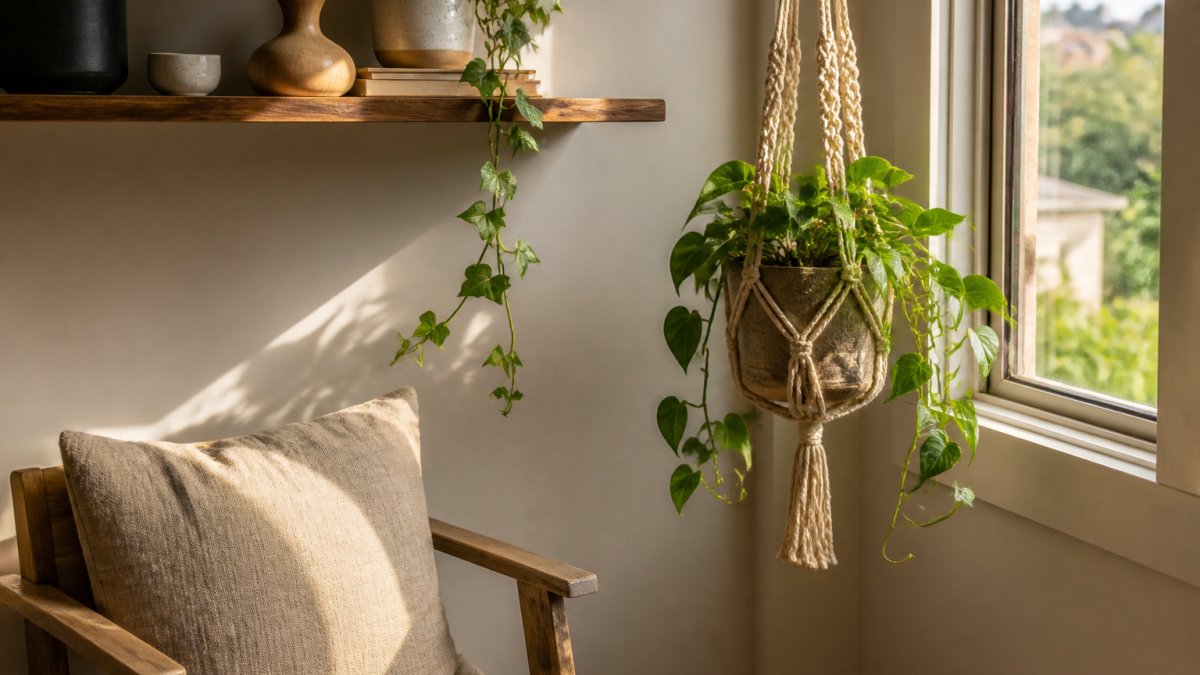
Our Macrame Plant Hanger ($39.95) hangs at a 1m drop and suits pots sized 10-20cm, so it lifts a plant off the floor without a single nail. Pair it with the Mr Kitly Self-watering Pots ($15.00), made in Melbourne, which let a plant drink from a waterwell at the base between top-ups.

For shelves, the Wooden Bud Vases from Parkinson Wood Co ($79.00) are cut from Tasmanian Huon Pine, Myrtle or Blackwood and designed for dried flowers. And the Nights Garden Cushions ($99.00) use a printed organic linen and hemp front with a natural cotton canvas back, made in Tasmania.
Good low-maintenance plants for a small, low-light flat:
- Snake plant
- ZZ plant
- Pothos
- Spider plant
Dried flowers and well-chosen faux stems also work, no water, no light.
Step 4: Find Ethical Home Decor Brands Australia Shoppers Can Trust
Ethical home decor brands Australia buyers can trust tell you where a piece is made and what from, and can show proof. Vague claims are a warning sign, and under Australian consumer law can be unlawful.
The Australian Competition and Consumer Commission guidance on environmental claims sets out what businesses can and cannot say about sustainability. In practice, that means a brand making a bold green claim should be able to substantiate it, and broad, unqualified words like "eco-friendly", "green" or "sustainable" without explanation are exactly the kind of claim the regulator watches. That gives you a useful filter: if a brand cannot explain a claim in plain language, treat it as unproven.
What to look for on a product page
A trustworthy listing usually answers most of these without you having to email:
- Named materials. "Organic linen and hemp" rather than "natural fabric".
- A named place of manufacture. A town or region, not just "designed in" a country.
- A maker or studio. Small-batch producers often name the workshop or the person.
- Care and repair information. Instructions for washing, oiling or re-covering a piece signal it is meant to last.
- A real returns policy. If you cannot return it, you cannot test it, and you are more likely to be stuck with something that does not fit.
What to be sceptical of
- Unqualified green language. "Eco" on its own tells you nothing about the material, the process or the end of life.
- Recycled content with no percentage. "Made with recycled materials" could mean 5 per cent or 95 per cent.
- Compostable claims on mixed-material items. A cushion with a compostable cover and a synthetic insert is not compostable.
- Carbon-neutral claims with no detail. Offsetting is not the same as reducing emissions, and the two are often conflated.
- Certifications you cannot verify. A logo is only useful if you can check what it covers and who issued it.
Why local and small-batch matters in a small flat
Locally made pieces cut freight emissions, but the bigger benefit for a renter is repairability. A maker you can contact can replace a part, re-cover a cushion or advise on a fix, extending the piece's life beyond a single lease.
That is the idea behind what we do at The Spotted Quoll: designed and made in Tasmania, in one of the last working studios of its kind here.
Two Things Most Guides Skip: Indoor Air Quality and What Happens at Disposal
Indoor air quality and disposal separate a genuinely green room from a green-looking one.
Indoor air quality. Small apartments have less air to dilute fumes. New furniture, paints, candles and synthetic fabrics can all release VOCs.
Disposal and circularity. Every decor item eventually leaves your home. Before buying, ask whether it can be repaired, rehomed, composted or recycled, a circular approach means fewer items, kept longer, passed on rather than binned.
Common Mistakes That Undo Eco-Friendly Home Decor for Small Apartments
The biggest mistake is buying for the room you have now, not the one you will rent next. Decor that only fits one layout becomes waste at moving time.
Other common errors:
- Chasing trends over timeless pieces. A neutral base with one or two prints lasts for years.
- Ignoring scale. Oversized furniture shrinks a small room.
- Trusting green labels without proof. Ask for detail.
- Skipping the disposal plan. If you cannot rehome it, do not buy it.
- Overfilling the space. Minimalism is not empty, it is deliberate.
A useful rule: if a piece does not earn its footprint, it does not come home.
Frequently Asked Questions
How can I make my small apartment more eco-friendly without spending a lot?
Start with what you already own. Decluttering first means you buy less, and anything you remove can be rehomed or donated rather than binned. When you do buy, choose secondhand or thrifted pieces, natural fibre textiles such as linen, hemp or wool, and items that serve more than one purpose. A single well-made cushion cover or plant hanger costs less over time than three cheap replacements, and it keeps material out of landfill.
What are the best sustainable materials for home decor in a compact space?
Look for natural fibres (linen, hemp, cotton canvas, wool), reclaimed or certified timber, and cork or bamboo for surfaces and flooring. These materials are renewable or reclaimed, and they tend to age well rather than peel or crack. Avoid pieces with strong chemical odours when new, as these often signal volatile organic compounds (VOCs) that affect indoor air quality in a small, poorly ventilated apartment.
Where can I find ethically made home decor in Australia?
Look for studios that state where a piece is made and by whom. The Spotted Quoll makes its cushions in Tasmania from printed organic linen and hemp with a natural cotton canvas back, and describes its production as ethical, zero waste and sweatshop free. Their macrame plant hangers are Fair Trade, and their wooden bud vases are crafted in Tasmania from Huon Pine, Myrtle or Blackwood by Parkinson Wood Co.
Are there eco-friendly storage solutions for small rental spaces?
Yes, and most avoid drilling. Use vertical storage such as over-door hooks, stackable baskets, under-bed boxes and freestanding shelving units that lift off the floor. Choose modular or multifunctional pieces, like an ottoman that stores bedding or a side table with a shelf. Buy secondhand where you can, and measure your space before purchasing so a storage piece does not become clutter itself.
Filling a small rental with decor that is kind to the planet and still feels like you is harder than it looks. The Spotted Quoll makes it simpler with natural-fibre homewares designed and made in Tasmania: exclusive nature-inspired prints, small-batch production, and pieces built to move with you. Browse the collection and choose a few things you will keep for years, not seasons.