Table of Contents
- What Makes Clothing Timeless and Versatile for Australian Made Goods
- Capsule Wardrobe Essentials Australia: Building Your Foundation
- Benefits of Natural Fibres in Clothing for Australian Climates
- How to Identify Australian Made Labels and Avoid Greenwashing
- The Real Value: Pricing Breakdown for Australian Made Goods
- Fabric Care and Longevity: Making Your Investment Pieces Last
- Circular Fashion: Resale Value and the Circular Economy
- Conclusion: Your Timeless and Versatile Wardrobe Starts Here
- Frequently Asked Questions
Last Updated: September 30, 2026
What Makes Clothing Timeless and Versatile for Australian Made Goods
Timeless and versatile clothing for Australian made goods is apparel designed to outlast trends, work across seasons, and suit multiple occasions without constant replacement. The best pieces share three traits: natural fibres, restrained design, and durable construction.
Capsule Wardrobe Essentials Australia: Building Your Foundation
Capsule wardrobe essentials Australia shoppers should prioritise are pieces that layer together, work across seasons, and survive frequent wear. A workable capsule starts with a neutral base, then adds one or two pieces with character.
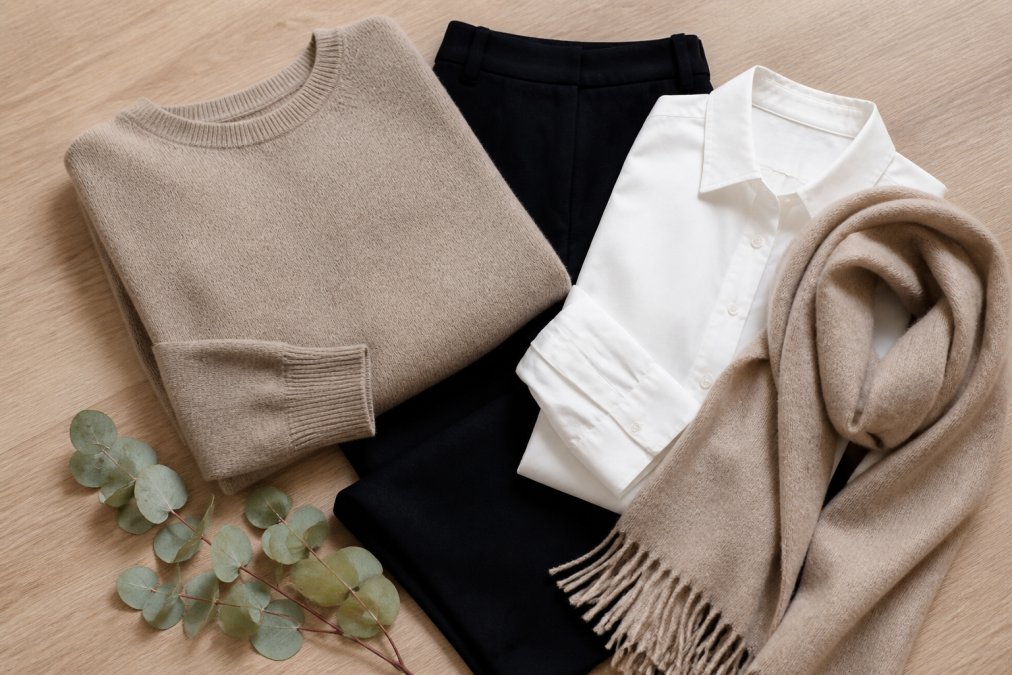
Numbered List: 7 Timeless Pieces That Work Year-Round
- A fine merino crew neck knit for layering under jackets
- A relaxed V-neck jumper for warmer days
- A textured Aran or cable knit for depth
- A mid-weight roll neck for winter
- Tailored neutral trousers
- A simple white or cream shirt
- A scarf or wrap in a nature-inspired print
The Phoebe Crew Neck Merino Knit is a good starting point. It is knitted from extra fine merino wool, made in Melbourne from Australian merino, and light enough to layer under a jacket without bulk. At $149, it is the foundation piece most capsules are built around.

Benefits of Natural Fibres in Clothing for Australian Climates
Natural fibres regulate temperature far better than synthetics, which matters when a single day swings from cold morning to warm afternoon. Merino wool breathes, wicks moisture, and resists odour, so it works in layers rather than fighting the weather.
Merino Wool: The Year-Round Australian Staple
Merino is the fibre that makes a genuine four-season wardrobe possible. It insulates when cold, breathes when warm, and holds its shape through repeated wear.
How to Identify Australian Made Labels and Avoid Greenwashing
Country-of-origin claims on goods sold here are also governed by the Australian Consumer Law, enforced by the ACCC. A business that makes a false or misleading origin claim can face penalties, and the ACCC has taken action against brands that overstated how much of a product was made locally. The practical takeaway: a genuine claim is specific and checkable, not atmospheric.
The Three Claims That Are Not the Same
- "Made in Australia", the substantial transformation test. The garment must be materially made here, not just finished or packaged.
- "Product of Australia", a stricter threshold, requiring all or virtually all of the significant ingredients and processing to be local.
- "Designed in Australia", a design claim only. It says nothing about where the garment was cut and sewn.
Watch for vague language like "designed in Australia" paired with offshore manufacturing. Design and manufacture are different claims, and only one tells you where the garment was actually sewn.
How to Verify a Claim in Under Five Minutes
- Look for the licensed Australian Made logo with the AMAG certification mark, not a hand-drawn kangaroo.
- Check the brand's website for a named maker, studio or factory, not just a country.
- Search the Australian Made Campaign's public licensee directory for the brand name.
- Ask directly: "Where was this garment cut and sewn, and by whom?" A brand with nothing to hide answers in specifics.
- Cross-check the fibre claim. "Australian merino" should mean the wool was grown here, not merely processed offshore and shipped back.
The Greenwashing Traps Specific to Clothing
Origin claims are only half the problem. Sustainability language is largely unregulated, so words like "eco", "conscious" and "natural" can appear on a garment with no supporting standard behind them. Three patterns are worth flagging:
- Vague fibre claims. "Bamboo" on a label often means viscose rayon processed from bamboo pulp, a chemically intensive process, not the raw plant. Look for the specific fibre name.
- Offset-as-solution. A brand that plants trees to cover a high-emission supply chain is treating a symptom. Local, small-batch production avoids much of the freight and volume problem in the first place.
- Recycled-content theatre. A single recycled trim on an otherwise synthetic, short-life garment is not a circular product.
The Real Value: Pricing Breakdown for Australian Made Goods
Australian made goods cost more because local wages, small-batch runs and local fibre carry real costs that offshore mass production avoids. The price reflects how the garment was made, not just what it is made of. Understanding those drivers is what turns a higher price tag from a deterrent into a rational decision.
Where the Money Actually Goes
| What You Pay For | High Street Equivalent | Australian Made |
|---|---|---|
| Fabric | Often synthetic blend | Natural fibres, local wool |
| Labour | Offshore, low wage | Local, fair wage |
| Production run | Mass volume | Small batch |
| Lifespan | One to two seasons | Several years |
| Repairs and resale | Rarely possible | Often supported |
Three drivers explain most of the gap. First, local wages: a garment sewn here carries an award-rate labour cost that offshore mass production does not. Second, small-batch economics: a run of a few hundred units spreads pattern-making, sampling and setup across far fewer garments than a run of tens of thousands, so each piece carries more of that fixed cost.
The Cost-Per-Wear Calculation
This is the number that actually matters, and it is the one fast fashion relies on you never running.
What You Are Actually Buying
- Repairability. Natural-fibre knitwear can be darned, re-knitted at the cuff and re-seamed. A synthetic blend that pills and loses shape usually cannot.
- Resale value. A well-made merino jumper holds a meaningful share of its original price on resale platforms, because the fibre and construction are still worth something to a second buyer. A fast-fashion knit typically resells for a fraction of its price, if at all.
- Fit stability. Garments cut for a small local run are less likely to be re-spec'd to a cheaper construction the following season, so the piece you loved in year one is still the piece you own in year four.
Before buying, divide the price by the number of wears you honestly expect. If a piece will be worn weekly for years, a higher upfront price is almost always the cheaper decision. If it will be worn twice, no price is low enough.
Phoebe Crew Neck Merino Knit - Uimi →
The Resale and Circular Angle
This is where the value case gets stronger than most pricing guides admit. A timeless merino piece has a second life: it can be resold, handed on, or repaired, keeping it out of landfill and recovering part of your outlay. That recovery is not available on a fast-fashion garment, which means the true cost of the local piece is its purchase price minus whatever you recover at resale.
Fabric Care and Longevity: Making Your Investment Pieces Last
Merino needs less washing than people assume. Wool is naturally odour-resistant, so airing a jumper between wears often replaces a full wash (Wool is naturally odour resistant).
- Wash cold on a gentle or wool cycle, or by hand
- Use a wool-specific detergent, never bleach
- Never tumble dry; dry flat in shade to hold shape
- Fold knitwear rather than hanging it
- Store folded with cedar or lavender against moths
Turn merino garments inside out before washing and dry them flat on a towel. This single habit prevents the stretching and pilling that shorten a knit's life more than wear ever does.
Circular Fashion: Resale Value and the Circular Economy
Well-made natural-fibre clothing holds resale value in a way fast fashion cannot. A merino jumper that survives years of wear can be resold, handed on, or repaired, keeping it out of landfill.
Conclusion: Your Timeless and Versatile Wardrobe Starts Here
Building a wardrobe that lasts takes patience, and it asks you to resist the seasonal replacement cycle. The reward is a smaller collection of pieces you actually reach for.
Frequently Asked Questions
What defines a timeless wardrobe in the context of ethical fashion?
A timeless wardrobe focuses on quality over quantity, featuring durable construction, classic silhouettes, and neutral colours that resist seasonal trends. In ethical fashion, it also means choosing pieces made from natural fibres like merino wool or linen, produced with supply chain transparency. These garments are designed for garment longevity, so they stay stylish and wearable for years, reducing textile waste and supporting conscious consumerism.
How can I identify genuine Australian made labels?
Check the label for phrases like 'Made in Australia' rather than 'Designed in Australia'. You can also verify claims by checking the brand's website for details about their local studio, textile sourcing, and manufacturing processes.
Why is investing in natural fibres better for a versatile wardrobe?
Natural fibres such as merino wool, cotton, and linen are breathable, temperature-regulating, and more durable than many synthetic alternatives. They hold their shape and colour better over time, making them ideal for capsule wardrobe pieces. Merino wool, for instance, is soft, moisture-wicking, and naturally odour-resistant, so it needs less washing. This means fewer garments replaced, a smaller carbon footprint, and better long-term value.
How do I build a capsule wardrobe using only Australian-made pieces?
Start with a foundation of 7 to 10 versatile items in a cohesive colour palette. Include a mix of tops, bottoms, and layers that can be worn across seasons. For example, a merino wool crew neck jumper works under a jacket in winter and over a dress in spring. Prioritise natural fibres and durable construction. Look for local brands that offer transeasonal designs and classic silhouettes, then add accessories to refresh your look.
Are Australian-made clothes more sustainable than fast fashion alternatives?
Generally, yes. Australian-made clothing often involves smaller-scale production with greater supply chain transparency, fair wages, and reduced carbon footprint from local manufacturing. Fast fashion relies on rapid turnover, synthetic materials, and often opaque overseas supply chains. Choosing locally manufactured, ethically produced garments supports slow fashion principles, reduces textile waste, and keeps money in the local economy.
How should I care for natural fibre clothing to make it last?
Always check the care label. Merino wool typically requires gentle hand washing or a cold wool cycle, then drying flat in shade. Avoid tumble drying, which can shrink fibres. Store folded rather than hung to prevent stretching. Airing garments between wears reduces the need for frequent washing. Proper care preserves garment longevity, keeps fibres soft, and maintains the piece's shape for years.