


Table of Contents
- What a Capsule Wardrobe Really Means After 50
- Minimalist Wardrobe Essentials for Women: The 12-Piece Starting Point
- Choosing a Neutral Palette That Works With Your Colouring
- Dressing for Your Shape: Flattering Cuts for Mature Figures
- Sustainable Fashion for Mature Women: Why Natural Fibres Matter
- Your Capsule Wardrobe Checklist for Older Women
- Caring for Your Capsule So It Lasts for Years
- Frequently Asked Questions
Last Updated: September 14, 2026
What a Capsule Wardrobe Really Means After 50
A capsule wardrobe is a small, curated collection of timeless pieces that mix and match to create a complete wardrobe with far fewer garments. For mature women, the goal is not less clothing for its own sake, but a wardrobe where every piece earns its place.
This guide from The Spotted Quoll is built around one idea most capsule advice ignores: after 50, the capsule is a fit and fabric exercise, not a style exercise.
The 3-3-3 Rule, Explained Simply
The 3-3-3 rule is a starting framework: three tops, three bottoms, three layering pieces, chosen so every item works with every other item. That nine-piece core produces dozens of combinations, which is why it suits anyone who wants a capsule wardrobe without a spreadsheet. Treat it as a prompt, not a law.
Why Frumpiness Is a Fit Problem, Not an Age Problem
Clothing does not become unflattering at a certain birthday. It becomes unflattering when the shoulder seam sits off the shoulder, the waistband digs, or the fabric clings in the wrong places.
Sizing up to hide the body adds volume where you least want it. Fix the fit and the age question disappears.
Minimalist Wardrobe Essentials for Women: The 12-Piece Starting Point
The minimalist wardrobe essentials for women over 50 come down to twelve pieces: four tops, three bottoms, three layering pieces, and two pairs of shoes. Twelve well-chosen garments cover work, weekends and everything between.
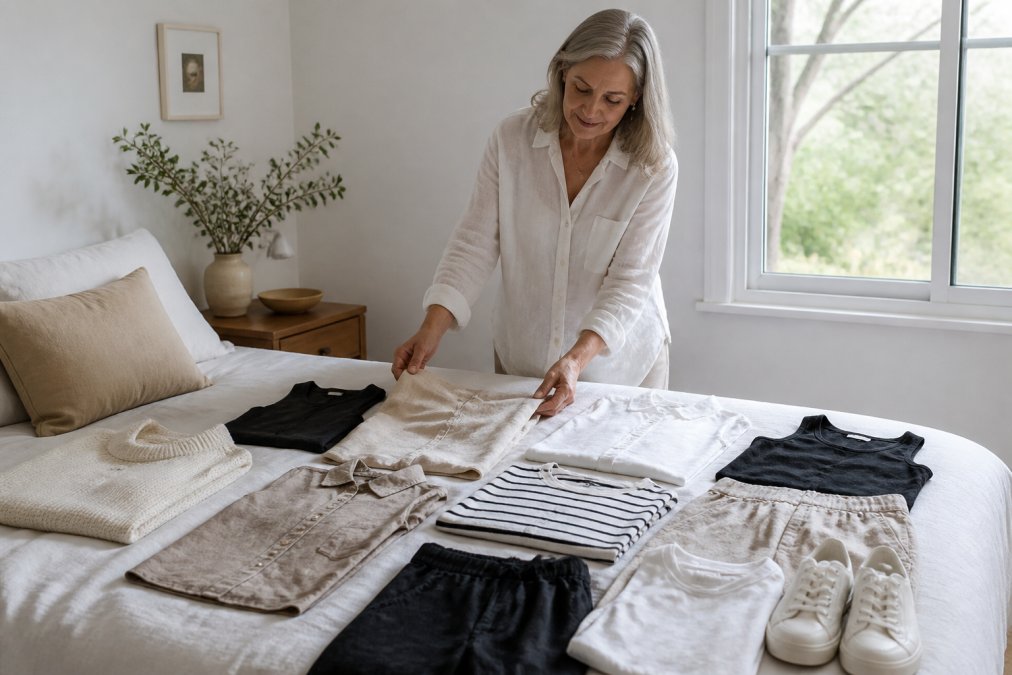
Tops and Base Layers
Start with four tops that work alone or under a layer. A linen shirt like the Linen Dion Blue Fine Stripe Short Sleeve Shirt ($199.00) earns its place because natural fibre breathes in heat. Add a printed piece such as the Linen Mini Pleat Top - Nights Garden ($198.00), whose pleated cut keeps fabric off the body. Two plain base layers round out the group, choose colours that sit against your face well, since these get worn most.

Bottoms, Knitwear and Outerwear
Three bottoms cover the week: one relaxed linen pant, one tailored trouser, one dark denim. The Boss Pant Organic 100% Linen - Coastal Fern ($299.00) uses an elastic waist and balloon leg, forgiving through the hip without looking shapeless.
For layering, a blazer does more work than a cardigan. The Island Pleat Denim Blazer ($228.00) is cut for year-round wear, while the Island Pleat Corduroy Blazer ($228.00) adds warmth without bulk. Both are size inclusive.


Choosing a Neutral Palette That Works With Your Colouring
A neutral palette is not limited to beige and grey, it is any group of colours that share an undertone, so everything sits together without clashing. Hold fabrics near your face in daylight: warm undertones lift with cream, camel and olive; cool undertones lift with charcoal, navy and soft white. Build your capsule around the two or three neutrals that flatter you, then add one accent colour you enjoy wearing.
Dressing for Your Shape: Flattering Cuts for Mature Figures
Flattering cuts for mature figures follow the body's current lines rather than the lines it had at 30. The changes that matter most after 50 are predictable: the shoulder line slopes and narrows, the waist-to-hip ratio flattens, the upper arm softens, and the bust and ribcage shift. Each has a specific cut that answers it.
Read Your Shape by Measurement, Not by Memory
In daylight, note three things: where your widest point sits (shoulder, bust, waist or hip), whether your waist indents more than about 5 cm from bust and hip, and whether your shoulder edge sits inside or outside your hip edge. Those place you in one of the four groups below. Re-check every two to three years.
Pear (Hip Wider Than Shoulder)
Build visual width above the waist so the eye reads balance. Choose a defined shoulder, a set-in sleeve, structured blazer, or shirt with a shoulder yoke, and keep the leg straight or gently flared rather than tapered, which narrows the ankle and makes the hip read wider by contrast. The Boss Pant Organic 100% Linen - Coastal Fern ($299.00) works because the balloon leg falls straight from the hip.
Apple (Waist Wider Than Hip)
Apple shapes gain most from vertical lines and a higher neckline. A V or scoop neck draws the eye down and inward; a vertical seam, pleat or open cardigan edge creates a lengthening column. Avoid a wide, stiff waistband that cuts across the middle. The Linen Mini Pleat Top - Nights Garden ($198.00) uses a pleated cut that keeps fabric off the body, exactly what an apple shape needs.
Rectangle (Waist Barely Indents)
Rectangle shapes create curve through construction, not the body. A belted or pleated waist, a peplum, or a wrap-style top all add the illusion of an indent. The Island Pleat Denim Blazer ($228.00) sits at the natural waist and adds a defined line where the body does not.
Inverted Triangle (Shoulder Wider Than Hip)
Soften the shoulder and add volume below. Choose a raglan or dropped shoulder over a structured set-in sleeve, skip shoulder pads, and pair with a wider or pleated leg, a straight-leg trouser makes the top half look heavier by comparison.
The Three Fit Levers That Matter Most After 50
- Shoulder seam. It must sit on the edge of your shoulder, not past it. A seam that sits past the shoulder pulls the whole garment across the chest and makes it look tight even when it is not.
- Waistband height and give. An elastic or gently fitted waist that sits at your natural waist flatters far more than a low, rigid one. A waistband that digs creates a horizontal line at the widest point.
- Armhole depth. As the upper arm softens, a deeper armhole stops the sleeve from cutting in. If you can pinch more than 2 cm of fabric at the underarm, the armhole is too shallow for comfort.
Sustainable Fashion for Mature Women: Why Natural Fibres Matter
Sustainable fashion for mature women is less about labels and more about what a garment is made from and how long it lasts. Natural fibres such as linen, organic cotton and wool regulate temperature and soften with wear; synthetic blends pill and hold odour.
At The Spotted Quoll, every piece is designed and made in Tasmania from natural fibres, with exclusive prints captured from nature. That local, small-batch approach is what keeps quality consistent.
Fabric Guide for Warmer and Cooler Climates
Choose fabric by climate, not by season alone.
| Climate | Best Fabric | Why It Works | Example Piece |
|---|---|---|---|
| Hot, humid | Organic linen | Breathes, dries fast, resists cling | Boss Pant, Linen Mini Pleat Top |
| Hot, dry | Cotton and linen blends | Light with a little structure | Linen Dion Shirt |
| Cool, wet | Organic cotton corduroy | Traps warmth, holds shape | Island Pleat Corduroy Blazer |
| Variable | Stretch cotton denim | Layers year-round | Island Pleat Denim Blazer |
Your Capsule Wardrobe Checklist for Older Women
A capsule wardrobe checklist for older women should be short enough to actually use. Work through it once, then revisit each season.
- Audit what you own and remove anything unworn for twelve months
- Identify your two or three best neutrals in daylight
- Check every shoulder seam and waistband for correct fit
- Confirm each garment is a natural fibre, named on the label
- Test that every top works with every bottom
- Add one accent colour, no more
- Fill gaps with one considered purchase, not five rushed ones
Caring for Your Capsule So It Lasts for Years
Garment care is where a capsule either pays off or falls apart. The difference between a linen shirt that lasts three summers and one that lasts ten is almost entirely in how it is washed, dried, stored and repaired. Most capsule guides stop at "wash cold", here is what actually happens to each fibre.
Why Natural Fibres Behave Differently
Linen, cotton, wool and silk are cellulosic or protein fibres, so they respond to water, heat and agitation predictably. Linen and cotton swell when wet and are strongest damp, so they tolerate a gentle machine cycle but weaken if spun hard or dried hot. Wool's scaly outer layer locks together under heat and agitation, the mechanism behind felting, so it needs cool water, low agitation and flat drying (Machine Washable Wool). Silk needs the gentlest treatment of all.
Washing: Frequency, Temperature and Cycle
- Wash less often than you think. Most natural-fibre garments only need washing every three to five wears unless visibly soiled. Air them between wears, a 20-minute hang in moving air removes most odour.
- Cool water, gentle cycle. 30°C or below protects fibre structure and colour; hot water accelerates shrinkage in cotton and felting in wool.
- Turn garments inside out. This protects the fabric face from friction against other garments and the drum.
- Use a mesh bag for knits and delicates. It reduces stretch and pilling.
- Skip fabric softener on natural fibres. It coats the fibre and reduces breathability, defeating the point of buying linen.
Drying: The Step Most People Get Wrong
- Linen and cotton: line dry in shade, or tumble on low briefly, then hang. Direct sun fades colour and weakens fibre.
- Wool and knitwear: dry flat on a towel, reshaped to its original dimensions. Hanging wet knitwear stretches the shoulder and hem permanently.
- Silk: roll in a towel to remove excess water, then dry flat away from heat.
- Denim: hang to dry. Heat breaks down stretch denim and fades indigo faster.
Stains: Act Fast, Treat by Type
- Grease (food, oil, cosmetics): blot, then apply a drop of dishwashing liquid and work in gently before washing, grease needs a surfactant, not just water.
- Protein (egg, dairy, blood): rinse in cool water first, since hot water sets protein stains permanently, then wash normally.
- Tannin (tea, coffee, wine): blot, then treat with cool water and a mild oxygen-based bleach. Never chlorine bleach on wool or silk.
- Ink: dab with methylated spirits on a cotton bud, working from the outside inward so it does not spread.
Storage: Seasonal and Everyday
- Knitwear: fold, never hang, hanging stretches the shoulder shape permanently.
- Blazers and structured pieces: hang on a shaped hanger wide enough to support the shoulder seam; a wire hanger distorts it within a season.
- Between seasons: wash before storing, since moths are attracted to soil and sweat residue, not clean fibre. Store clean wool and silk in breathable cotton bags, not plastic, which traps moisture and encourages mildew.
- Cedar and lavender deter moths without mothball chemicals. Refresh cedar blocks by lightly sanding them yearly.
Repair Early, Repair Well
- Loose buttons: re-stitch at the first sign of movement, a button lost mid-wear takes the garment out of rotation.
- Fraying seams: a 5-minute repair now prevents a 30-minute one later. One basic backstitch handles most seam repairs.
- Pilling on knitwear: use a fabric shaver or fine comb, not a razor. Pilling is normal on natural fibres and does not mean the garment is worn out.
- Small holes in wool: a darning stitch or felting needle closes them invisibly; many menders do this for a few dollars per hole.
Rotation: The Simplest Longevity Trick
Rotate your pieces so no single garment takes all the wear. Twelve pieces worn evenly will outlast the same twelve worn unevenly by years, because fibre fatigue is cumulative. If one piece is always in the wash and another always on the hanger, you have a rotation problem, not a wardrobe problem.
Frequently Asked Questions
What should women over 60 wear in a capsule wardrobe?
Start with pieces that suit your shape and climate rather than your age. A workable core is two pairs of well-cut trousers, one or two skirts, three tops in breathable natural fibres, a knit layer, a blazer and a pair of comfortable leather shoes. Keep the palette to two neutrals plus one accent so everything mixes. Fit matters more than trend: shoulder seams should sit on your shoulder, and hems should fall where you want them, not where a size chart assumes.
What is the 3-3-3 rule for a capsule wardrobe?
The 3-3-3 rule is a planning shortcut: three tops, three bottoms and three pairs of shoes, which gives you 27 outfit combinations from nine items. It works because each piece has to coordinate with the others, so you stop buying things that only match one garment. Treat it as a starting framework rather than a strict limit, and add layers, outerwear and accessories once the base is working. Many women use it as a seasonal reset rather than a permanent cap.
How do I choose a colour palette for a mature capsule wardrobe?
Pick two neutrals you already wear often, such as navy and oat, or charcoal and cream, then add one accent colour you enjoy. Hold each new piece against your face in daylight before buying; if your skin looks grey or washed out, the tone is wrong for you. Warmer complexions usually suit cream, camel and olive, while cooler ones carry grey, navy and berry well. A tight palette is what makes a small wardrobe feel larger.
Why are natural fibres better for a sustainable capsule wardrobe?
Natural fibres such as linen, organic cotton and wool breathe, which matters in Australian heat where synthetics trap moisture and cling. They also tend to age better, so a garment stays wearable for more seasons instead of pilling or losing shape after a few washes. Longer wear is the single biggest environmental gain in a wardrobe, since it spreads the cost and the impact of each piece across years rather than months. Check the care label before you buy.
How do I transition a capsule wardrobe between seasons?
Swap the layers, not the whole wardrobe. Keep your base tops and trousers year-round and change the knit, blazer or coat on top. A cotton denim blazer works through most of the year, while a corduroy version handles the colder months. Store off-season pieces clean and folded, and take five minutes at each changeover to note what you did not wear. That gap is usually the clearest signal of what to stop buying.
How can mature women dress stylishly without looking frumpy?
Frumpiness usually comes from poor fit, not from age. Check three things: the shoulder seam sits on the shoulder, the waist sits at your natural waist rather than below it, and the hem length is deliberate. Structured pieces such as a blazer sharpen a relaxed linen top, and a defined silhouette reads more polished than loose layers everywhere. Add one considered accessory, then stop. Restraint is what separates classic style from a costume.
What are the essential items for a capsule wardrobe for women over 60?
The essentials are a classic button-through shirt, a printed or plain linen top, one pair of easy elastic-waist trousers, one tailored pant, a knit layer, a blazer, a dress that works for day and evening, and comfortable leather shoes. Add a coat for your coldest months and a scarf or two. The exact list matters less than the rule behind it: every piece must combine with at least three others you already own.
How do I build a capsule wardrobe on a budget?
Buy fewer pieces and spend more per piece on the ones you wear weekly. A $198 linen top worn twice a week for three years costs far less per wear than a $40 synthetic top replaced every season. Build in stages: buy the trousers and shoes first, since they take the most wear, then add tops and layers over the following months. A wardrobe audit before you shop will usually show you already own more than you think.
Building a capsule that fits your shape, suits your climate and survives more than a season takes more thought than a shopping list allows. The Spotted Quoll designs and makes natural-fibre pieces in Tasmania specifically for this: size-inclusive cuts, exclusive nature-inspired prints, and transeasonal designs built to mix. Explore the collection and start with one piece that works with what you already own.