Table of Contents
- How Smitten Merino and Local Labels Compare at a Glance
- The Benefits of Australian Made Clothing for Your Wardrobe
- Merino Wool and Natural Fibres: Performance, Biodegradability and Care
- Third-Party Certifications and Ethical Manufacturing Claims
- Sustainable Capsule Wardrobe Essentials from Local Labels
- Price-Per-Wear: Why Cost Per Wear Beats Upfront Price
- Frequently Asked Questions
Last Updated: September 16, 2026
How Smitten Merino and Local Labels Compare at a Glance
Choosing between smitten merino vs local sustainable brands comes down to one question: are you buying a fibre, or a supply chain you can trace? Smitten Merino is a Tasmanian label built around merino basics, while studio-based makers such as The Spotted Quoll combine natural fibres with exclusive nature-inspired prints and small-batch production. This guide breaks down where each approach wins.
What the Comparison Table Reveals
| What You're Comparing | Smitten Merino | Local Studio Labels |
|---|---|---|
| Core strength | Merino basics and layering pieces | Merino plus printed, nature-inspired designs |
| Fibre focus | Merino wool | Merino, natural fibres, transeasonal blends |
| Production model | Established label, scaled output | Small-batch, studio-based runs |
| Design signature | Minimal, plain knitwear | Exclusive prints, seasonal capsule pieces |
| Traceability | Brand-level sourcing statements | Maker-level visibility, studio to shelf |
| Best for | Wardrobe basics you replace often | Pieces you keep and restyle for years |
If you want a plain merino layer at volume, a large merino label serves that need well. If you want a design identity and a maker you can name, a studio label does something the bigger players cannot.

The Benefits of Australian Made Clothing for Your Wardrobe
Australian made clothing gives you shorter supply chains, easier traceability, and a garment built for local conditions. When a piece is cut and finished close to where it is sold, there are fewer hands, freight legs, and unknowns between the fibre and your wardrobe.
Local Production vs Offshore Manufacturing
Offshore manufacturing is not automatically worse, just harder to verify. A garment can be assembled overseas and still carry a local label if the branding happens here, which is why "designed in" and "made in" mean different things.
Local production changes the maths:
- Shorter freight distances reduce the carbon footprint of getting a garment to you
- Smaller runs mean less unsold stock heading to textile waste
- You can ask a maker directly about fibre processing, dyeing, and labour
- Repairs and alterations are more likely to be possible
Merino Wool and Natural Fibres: Performance, Biodegradability and Care
Merino wool regulates temperature, resists odour, and holds its shape better than most synthetic knits. It is renewable and, as a natural fibre, breaks down at the end of its life rather than persisting in landfill like polyester.
Comparative Fabric Performance and Garment Longevity
Synthetics tend to pill and hold odour over time. Merino can felt or shrink if mistreated, but a well-cared-for knit keeps its structure for years.
Third-Party Certifications and Ethical Manufacturing Claims
Third-party certification is the closest thing the fashion industry has to proof: an independent body has audited a claim rather than the brand marking its own homework. Most shoppers cannot tell a meaningful standard from a logo, so here is what the common wool and textile certifications actually verify, and what they do not.
- Responsible Wool Standard (RWS), audits animal welfare and land management on the farm, and traces the certified wool through the supply chain (Responsible Wool Standard (RWS)). It does not cover the garment factory.
- Global Organic Textile Standard (GOTS), covers organic fibre content and processing, including restricted chemical lists for dyeing and finishing, plus social criteria at the processing stage. It applies to the textile chain, not the farm.
- OEKO-TEX Standard 100, tests the finished article for harmful substances (OEKO-TEX® STANDARD 100). It says nothing about how the fibre was grown or how the garment was made.
- Fair Trade certification, focuses on labour conditions and pricing at the manufacturing site. It is not a fibre standard.
- ZQ Merino, a grower-level programme covering animal welfare, social responsibility and environmental management on the farm.
What Certification Does Not Tell You
A certification is a floor, not a ceiling. It confirms defined criteria were met at a point in time, not that the garment will last, fit you, or be repaired in three years. It also does not cover every stage, a GOTS-certified fabric can still be cut and sewn in a factory with no labour accreditation.
Sustainable Capsule Wardrobe Essentials from Local Labels
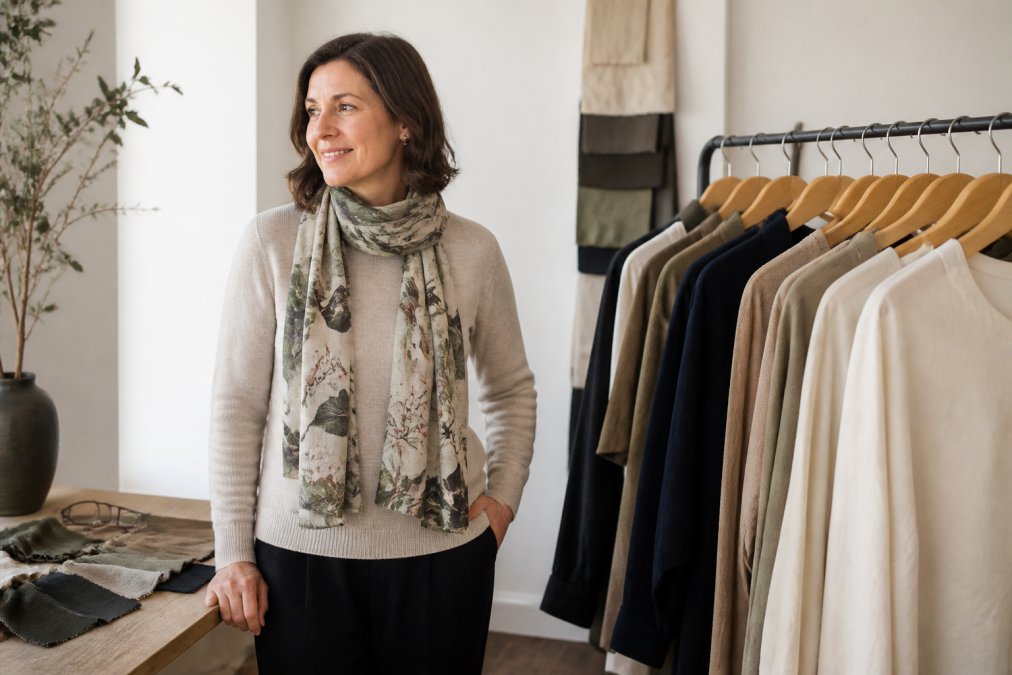
A sustainable capsule wardrobe is a small set of garments that work together across seasons, reducing how much you buy and discard. The goal is a rack where almost everything pairs with almost everything else.
Build the Capsule Around Fibre Weight, Not Colour
Most capsule advice starts with a colour palette, but for wool a more useful starting point is fibre weight, because weight determines when you can wear a piece and how to care for it. A practical local-wool capsule runs across four weights:
Phoebe Crew Neck Merino Knit - Uimi →
- Fine-gauge merino (around 150-200 gsm), a lightweight crew or cardigan that layers under a jacket and works across three seasons. Hand wash cold, dry flat.
- Mid-weight merino (around 250-300 gsm), a standard jumper for winter. Hand wash cold, dry flat, reshape while damp.
- Chunky or aran-weight merino (300 gsm and up), an outer layer for cold days. Hand wash cold only, dry flat away from direct heat.
- Merino-blend accessories, beanies, scarves and gloves, often blended with a small amount of nylon or elastane for shape retention. Check the care label, because a blend can usually take a gentler machine cycle than pure merino.
How to Style Nature Inspired Prints for Work and Weekends
Nature inspired prints are easier to wear than most people expect: treat the print as the single focal point and keep everything around it plain.
Three rules that hold up in practice:
- One print per outfit, maximum
- Keep the base layer a solid colour drawn from the print itself
- Match the fibre across layers so the textures sit together
Care Rules That Keep a Capsule Alive
The capsule only pays off if the garments survive. Merino care rules are simple:
- Wash cold, by hand, with a wool-safe detergent. Heat and agitation felt the fibres permanently.
- Never tumble dry. Press the water out in a towel and dry flat, reshaping to the original dimensions.
- Store folded, not hung, so shoulder seams do not stretch.
- Air between wears rather than washing after every use, merino resists odour, so a day on a hanger often resets it.
- Store with a natural moth deterrent such as lavender or cedar, and check pieces at the start of each season.
Price-Per-Wear: Why Cost Per Wear Beats Upfront Price
Price per wear is the upfront cost divided by the number of times you wear the garment. A $149 jumper worn 100 times costs $1.49 per wear; a $40 jumper worn six times before it pills costs $6.67. The cheaper garment is the more expensive one.
Work through it honestly:
| Garment | Upfront Cost | Wears Per Year | Years Worn | Cost Per Wear |
|---|---|---|---|---|
| Fine merino crew knit | $149.00 | 40 | 5 | $0.75 |
| Chunky merino beanie | $85.00 | 60 | 4 | $0.35 |
| Merino fingerless gloves | $75.00 | 50 | 4 | $0.38 |
| Merino wool tights | $47.50 | 30 | 3 | $0.53 |
Frequently Asked Questions
What are the benefits of choosing locally made sustainable clothing?
Local production shortens the supply chain, which makes traceability easier and reduces the carbon footprint of transport. It also supports small-batch makers and keeps money in the local economy. Garments made close to home often come with clearer information about fibre origin and working conditions. For merino pieces, buying locally means you can ask direct questions about the wool source, the spinning process and the dyeing methods used, rather than relying on a label alone.
How does merino wool compare to other sustainable natural fibres?
Merino wool regulates temperature, resists odour and needs less frequent washing than cotton or synthetics, which extends its useful life. It is a renewable resource and biodegradable at end of life. Compared with cotton, merino typically requires less water per garment and performs better across seasons. The trade-off is cost and care: merino needs gentle hand washing in cold water to avoid shrinkage, while cotton is more forgiving in the machine. For layering pieces, merino's warmth-to-weight ratio is hard to match.
What should I look for when verifying a brand's ethical credentials?
Ask for specifics rather than slogans. Look for named certifications, published supplier lists, and clear statements about where fibre is grown and where garments are made. Check whether the brand can explain its spinning, dyeing and finishing steps. Non-mulesed wool claims should be verifiable through the grower or supplier. If a brand cannot answer basic questions about its supply chain transparency, that silence is informative. Third-party certification breakdowns and audit reports carry more weight than a sustainability page.
How do I build a capsule wardrobe using local sustainable labels?
Start with a small number of versatile natural fibre pieces that work across seasons. A lightweight merino knit, a chunky scarf, a beanie and fingerless gloves cover most cold-weather needs and layer together. Choose neutral colours for the base and add one or two nature-inspired prints for interest. Focus on garment longevity: buy pieces you will wear at least 30 times a year, and check care instructions before purchase. Fewer, better-made items reduce textile waste and make daily dressing simpler.
Are there other Australian brands focusing on nature-inspired prints?
Yes, several local labels work with botanical and wildlife motifs, but the depth of ethical manufacturing varies widely. When comparing, look at whether prints are exclusive to the brand, whether they are digitally printed or screen printed, and what inks are used. Exclusive prints tend to hold their value and are less likely to appear on fast-fashion copies. Ask whether the print is designed in-house and how it connects to the brand's broader commitment to responsible sourcing and slow fashion.