Table of Contents
- Why Australian Made Clothes Cost More: The Real Numbers
- The Cost Per Wear Calculation That Changes Everything
- Best Sustainable Fashion for Women: What to Look For
- How to Build a Capsule Wardrobe Around Investment Pieces
- Durability and Garment Longevity: Fast Fashion vs Local Manufacturing
- How to Tell If Clothing Is Genuinely Australian Made
- Conclusion: When the Price Tag Tells the Real Story
- Frequently Asked Questions
Last Updated: September 24, 2026
Why Australian Made Clothes Cost More: The Real Numbers
The question of whether australian made clothes are worth the price starts with understanding why the price is what it is. At The Spotted Quoll, we've watched customers hesitate at a $298 dress. That gap isn't arbitrary. It reflects two entirely different production systems, and once you see the breakdown, the number stops looking like a markup and starts looking like a receipt.
Manufacturing Overhead and Labour Standards
A local garment carries costs an overseas factory never sees. Australian makers pay award wages, superannuation, workers' compensation insurance, studio rent, and power bills that reflect local rates. Small-batch production means pattern grading, cutting, and sampling are spread across fewer units, so each piece absorbs more of the setup cost.
Textile Quality and Raw Materials
Fabric choice separates investment pieces from disposable ones. Natural fibres like organic cotton poplin, pure linen, and extra-fine merino wool cost more per metre than synthetic blends, and they behave differently on the body. Linen and cotton breathe in heat; polyester traps it. A local maker sourcing quality raw materials pays a premium that shows up in the final price, but also in how the garment feels after its twentieth wear.

The Cost Per Wear Calculation That Changes Everything
The cost per wear calculation is the single most useful tool for judging whether a garment is expensive or cheap. Divide the purchase price by the number of times you realistically wear it. A $60 dress worn four times costs $15 per wear. A $298 dress worn eighty times costs under $4 per wear.
| Garment | Price | Wears | Cost Per Wear |
|---|---|---|---|
| Fast fashion dress | $60 | 5 | $12.00 |
| Mid-range dress | $150 | 30 | $5.00 |
| Local investment dress | $298 | 90 | $3.31 |
Best Sustainable Fashion for Women: What to Look For
The best sustainable fashion for women is clothing that survives trends, washes well, and comes from a maker who can explain where the fabric came from. Sustainability isn't a label you can print on a tag; it's a set of verifiable practices behind the garment. Most articles stop at that sentence. The useful part is the verification method, so here is the framework to apply before you spend.
Read the fibre content before the marketing copy
Fibre is the single most predictive detail on a garment. A maker can change a print or a cut in a season, but the fibre determines how the piece ages, how it breathes, and how it washes. Compare these common options on the criteria that actually affect cost per wear:
- Organic cotton, breathable, holds shape, softens with washing. Look for a stated organic certification rather than the word 'natural'.
- Pure linen, the strongest natural fibre for heat, gets softer over years, creases by design. A linen garment that pills is usually a blend.
- Merino wool, temperature-regulating and odour-resistant, so it needs washing less often. Fine-gauge merino holds shape when stored folded.
- Synthetic blends, cheaper per metre and often added for stretch or drape, but they pill, hold odour, and shed microplastics in the wash.
The three-question greenwashing test
Greenwashing is the practice of marketing a garment as ethical or eco-friendly without verifiable evidence behind the claim. Detecting it takes three questions:
- Who made it? A named studio, factory or region is checkable. 'Ethically made' is not.
- Where was the fabric sourced? Fibre origin and mill matter as much as the sewing floor.
- What happens at the end of its life? Repairs, take-back or compostability claims should be specific, not aspirational.
Construction details that separate investment from disposable
Fibre gets the attention, but construction decides whether the garment reaches its hundredth wear. Check for:
- Reinforced seams, flat-felled or French seams on high-stress areas resist fraying.
- Functional pockets, a maker who includes real pockets is designing for wear, not for a lookbook.
- Finished hems and facings, raw or overlocked edges on a $300 garment are a warning sign.
- Spare buttons and a seam allowance, both signal the maker expects the piece to be repaired, not replaced.
Supply chain transparency, from fibre to finished garment
Transparency is a spectrum, not a badge. At the weakest end, a brand says 'designed here' and nothing else. At the strongest, it can trace the fibre to a farm or a named mill, the fabric to a printer or dyehouse, and the garment to a specific studio. Ask a brand directly where each stage happens.
How to Build a Capsule Wardrobe Around Investment Pieces
Building a capsule wardrobe means choosing a small number of garments that combine into many outfits across seasons. The goal isn't minimalism for its own sake; it's removing the daily friction of a wardrobe full of pieces that don't work together.
Durability and Garment Longevity: Fast Fashion vs Local Manufacturing
Garment longevity comes down to three things: fibre quality, construction, and how you care for the piece. Fast fashion optimises for the first sale, not the fiftieth wear. Local manufacturing optimises for repeat customers, which means the garment has to survive. The gap between those two incentives is where the price argument is won or lost, and most of it happens after you get the garment home.
Why fast fashion fails early
A cheap garment is engineered to a price, and the compromises show up in predictable places. Lower-grade fibres are shorter, so they pill and break faster. Seams are overlocked rather than reinforced, so they split at stress points. Dyes are less colourfast, so the piece fades before it wears out. The result is a garment that looks tired after a handful of washes, which triggers replacement, and the replacement cycle is the hidden cost that never appears on the tag.
Wonderland Dress - Sawtooth Banksia →
The care habits that add years
The single biggest lever on garment lifespan is how often you wash it. Washing less frequently, at lower temperatures, and drying flat where the fabric allows adds years to natural-fibre pieces. The practical routine:
- Wash less often. Merino and linen can be aired between wears; spot-clean where you can.
- Use cold water and a gentle cycle. Heat is what shrinks wool and fades dye.
- Dry flat, out of direct sun. Hanging wet knits stretches them out of shape.
- Store knits folded, not hung. Hangers distort shoulders over time.
- Repair early. A loose button or a small seam split costs minutes to fix and prevents a larger failure.
The cost-per-wear maths of care
Care changes the arithmetic directly. A $298 dress worn 90 times costs about $3.31 per wear. Extend that to 180 wears through better washing and a repair or two, and the same dress costs roughly $1.66 per wear, cheaper than a $60 fast-fashion dress worn five times at $12.00 per wear. Longevity isn't a feeling; it's a number you can calculate before you buy.
What local manufacturing does differently
Local makers have a structural reason to build for longevity: their customers can come back, complain, and expect a repair. That accountability shows up in construction choices, reinforced seams, quality interfacing, spare buttons, and a seam allowance that allows alteration. It also shows up in fibre choice, because a maker who has to stand behind a garment for years will not risk a fibre that fails in the first season.
Repair, resale and the end of life
The final longevity lever is what happens when a garment does wear out. Local makers are more likely to offer repairs, alterations or take-back because the garment was made nearby. Before you buy, ask whether the brand repairs its own pieces. A yes is a signal that the garment was built to be maintained, not discarded, and it is one of the clearest differences between a piece worth the price and one that isn't.
How to Tell If Clothing Is Genuinely Australian Made
Genuine local production is verifiable, and the verification starts at the label. Look for a clear "Made in Australia" claim rather than "Designed in Australia," which only describes where the idea originated, not where the garment was cut and sewn.
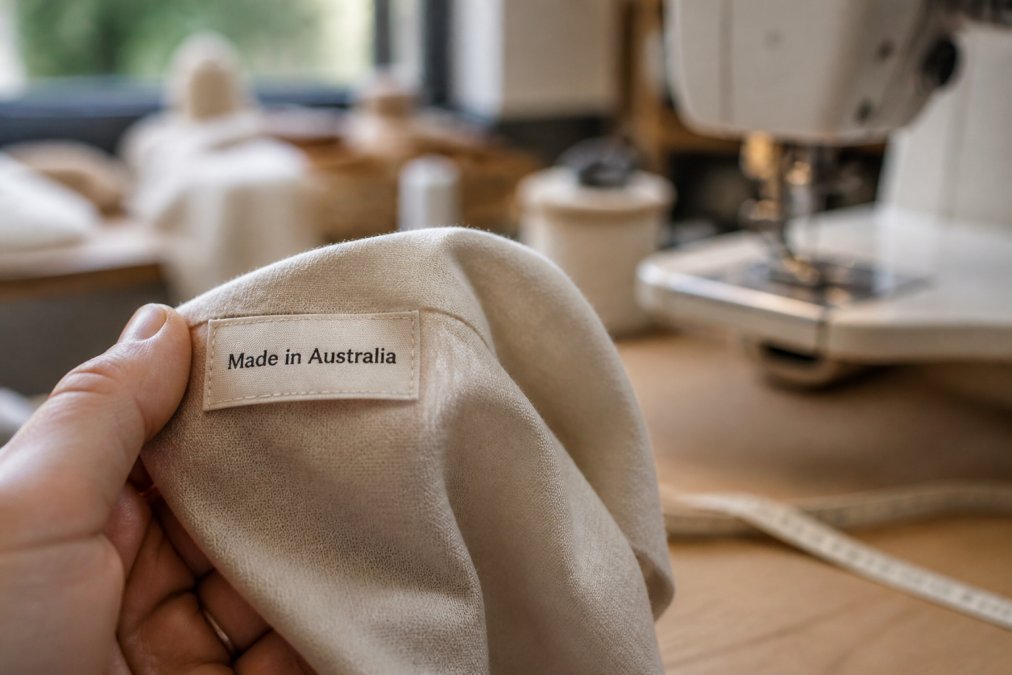
Use this checklist before you buy:
- Does the label say "Made in Australia" or "Australian Made," not just "Designed in"?
- Can the brand name the studio or region where the garment was produced?
- Is the fibre content stated specifically, not as a vague blend?
- Does the brand describe its supply chain without prompting?
- Are the garment's care instructions detailed enough to protect your investment?
Conclusion: When the Price Tag Tells the Real Story
The honest answer to whether australian made clothes are worth the price is that it depends on how you measure value. If you count only the number on the tag, local clothing loses. If you count cost per wear, garment longevity, and the labour standards behind the seams, the arithmetic flips.
Frequently Asked Questions
What is the difference between 'designed in' and 'made in' Australia?
A 'designed in' label means the concept and patterns were created locally, but the garment could be manufactured overseas. 'Made in' means the item was physically produced here. The Australian Made logo requires the product to be substantially transformed in Australia. Always check the label for the specific wording.
How does the cost per wear calculation work for Australian made clothes?
Divide the purchase price by the number of times you wear the item. A $298 dress worn 100 times costs $2.98 per wear. A $60 fast fashion dress worn five times before it loses shape costs $12 per wear. Quality garments made from natural fibres hold their structure longer, so the cost per wear calculation often favours the higher-priced piece over time.
How can I tell if a brand is greenwashing or genuinely ethical?
Look for specific, verifiable claims rather than vague terms like 'eco-friendly'. Genuine brands name their fabric suppliers, explain where garments are cut and sewn, and can tell you the fibre content. Certifications like the Australian Made logo or ethical accreditation schemes add credibility. If a brand cannot answer basic supply chain questions, treat the sustainability messaging with caution.
What are the benefits of buying Australian made clothing?
Local manufacturing supports jobs, keeps skills in the community and often means shorter supply chains with better labour standards. Natural fibres like organic cotton and merino wool suit the climate and last longer than synthetic blends. You also get greater supply chain transparency because you can trace where the garment was made and by whom, which helps you avoid fast fashion pitfalls.