


Table of Contents
- Why Durable Clothing Is the Foundation of a Capsule Wardrobe
- Sustainable Capsule Wardrobe Essentials: The 7 Pieces Worth Buying Once
- How to Read Fabric Durability Before You Buy
- Cost-Per-Wear: The Maths That Justifies Buying Well
- How to Care for Natural Fibre Garments So They Last
- Natural Fibre Clothing Brands: What to Look For
- Repair and Maintenance: Keeping Durable Clothing in Rotation
- Frequently Asked Questions
Last Updated: September 10, 2026
Why Durable Clothing Is the Foundation of a Capsule Wardrobe
A capsule wardrobe only works if the garments survive. Durable clothing for capsule wardrobes is the difference between rebuilding every season and a wardrobe that improves with wear. At The Spotted Quoll, our pieces are designed to be worn for years, that repetition is the point.
Here's the tension most capsule guides skip: a small wardrobe multiplies wear. Own thirty tops and each gets worn a dozen times a year; cut that to eight and each is on your back forty-plus times. Every weak seam and thin fibre gets tested far harder than in an overflowing closet.
That's why a Textile Institute fibre durability overview matters more than a colour palette. A capsule built on flimsy fabric fails within eighteen months (ellenmacarthurfoundation.org). A capsule built on natural fibres, sound construction and honest care lasts a decade.
Below: seven pieces worth buying once, how to read fabric durability before you spend, and the habits that keep them in rotation.
Sustainable Capsule Wardrobe Essentials: The 7 Pieces Worth Buying Once
Sustainable capsule wardrobe essentials earn their place through versatility, fabric quality and construction, not trend appeal. The seven pieces below cover work, weekend and travel across every season. Most capsule lists hand you a shopping list and stop there; the real skill is knowing what makes one linen pant outlast another, fibre, weight and finishing.
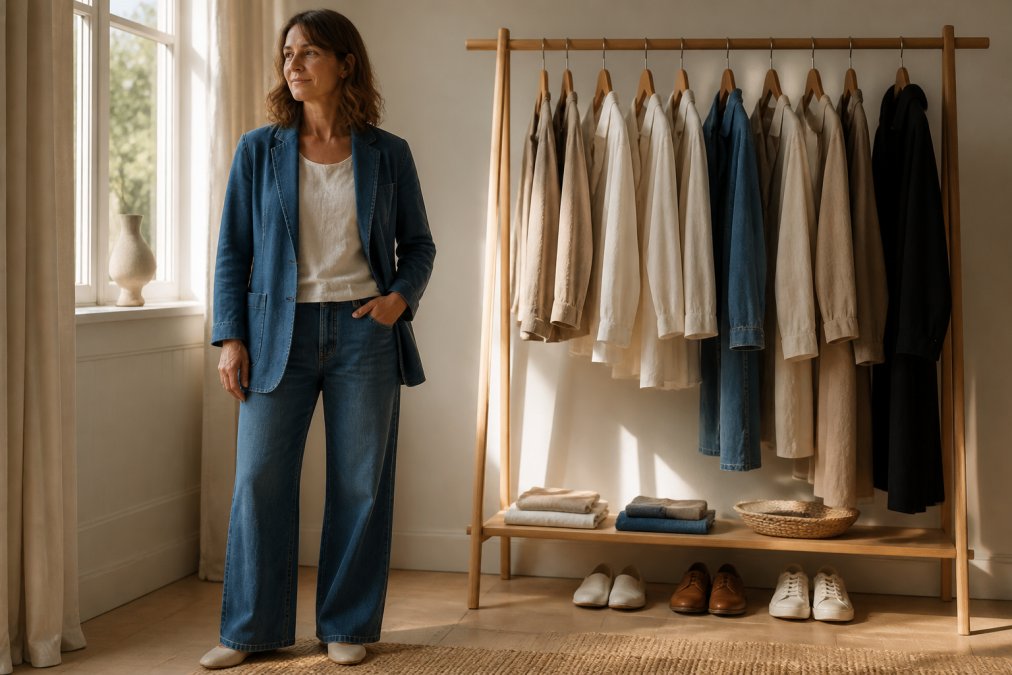
1. The Structured Blazer That Works Year-Round
A blazer is the hardest-working layer in a capsule because it lifts a plain outfit without extra thought. Our Island Pleat Denim Blazer is cut from 97% cotton and 3% elastane at roughly 300gsm, enough body to hold a shape while still moving with you. The back inverted pleat and princess seams define the waist without stiffness.

For colder months, the Island Pleat Corduroy Blazer swaps in organic cotton corduroy with a touch of stretch. Same silhouette, different weight, one pattern, two seasons, exactly how a modular wardrobe should work.

2. Wide-Leg Jeans Built From Stretch Denim
Denim is where capsule wardrobes usually break down, because cheap stretch denim bags at the knee within a season. Look for high cotton content and a stated fabric weight. Our Stretch Denim Jeans sit at 97% cotton and 3% elastane, around 300gsm, with a contrast waist facing and centre back invisible zip.
For a lighter option, the Nova Jeans use a flat front with side elastic for a variable fit. That elastic is a comfort win but the first thing to wear out, so rotate this pair rather than wear it five days straight.
3. The Elastic-Waist Linen Pant
The Boss Pant is our best-selling cut: a balloon leg, double pockets and an elastic waist that handles a long lunch as well as a long flight. It's made from 190gsm pure organic linen, the weight that matters. Lighter linen creases into oblivion; heavier linen drapes and softens with every wash.

The Boss Pant in Black Staple does the same job in a neutral that pairs with everything else on this list, the pant that anchors a neutral palette.
4. A Merino Knit That Breathes
Merino is the most misunderstood fibre in a capsule. It regulates temperature, resists odour and needs far less washing than cotton, which is why it lasts. The Astrid Fair Isle Jumper is 100% Australian merino, whole-garment knitted in Melbourne, so there are no bulky side seams to rub or split. Don't treat wool as winter-only: a mid-weight merino knit works in three seasons, and airing it between wears replaces most washing.
How to Read Fabric Durability Before You Buy
Fabric durability comes down to three things you can check in under a minute: fibre content, fabric weight and construction details. Ignore the marketing copy and read the label.
Start with the percentage breakdown. A garment listed as "linen blend" might be 30% linen and 70% polyester, and that polyester is what pills and holds odour. Long-staple natural fibres like linen, merino and quality cotton have fewer loose ends, so they resist pilling and abrasion far better than short-staple or synthetic blends. A synthetic blend also has a different elasticity to the natural fibre, so the two wear at different rates and the surface breaks down faster.
Next, look for weight. Linen around 190gsm and denim around 300gsm hold their shape without feeling heavy. A lightweight fabric has less fibre mass to absorb friction, so it thins and tears sooner; a mid-weight fabric distributes that stress across more fibres. If a brand doesn't state gsm, hold the fabric up to light: if you can see your hand through it, it's too light for heavy rotation.
Then check the finishing: French or bound seams, topstitching along stress points, reinforced pocket corners and a spare button sewn inside. These details cost the maker money, and their presence tells you the rest of the construction was taken seriously. Test construction in the fitting room: tug a seam sideways, if the stitches gape, the seam allowance is too narrow or the stitch too long. Rub the fabric between your fingers for ten seconds: if it pills or feels fuzzy, it will pill in wear. Twist a section and release it: good natural fibres spring back, while poor blends stay creased.
| What to Check | Weak Sign | Durable Sign |
|---|---|---|
| Fibre content | "Blend" with no percentages | Named fibres with percentages |
| Fabric weight | Unstated or very light | Stated gsm in a mid range |
| Seams | Overlocked only | Bound or French seams |
| Stress points | No topstitching | Topstitched, reinforced corners |
| Spare button | None included | Sewn inside the garment |
| Hand feel | Slippery, thin, or plasticky | Dry, dense, with visible weave |
| Recovery test | Stays creased when twisted | Springs back when released |
How to Care for Specific High-Quality Materials
Once you've bought well, care determines whether the garment lasts three years or ten. Most capsule guides stop at "wash cold," but different fibres need different handling.
Linen is strongest when wet, so it handles a gentle machine wash but loses strength if spun too hard. Wash at 30°C on a low spin, and don't overload the machine. Linen creases naturally, a sign of fibre integrity, not poor quality. Steam iron on the reverse while slightly damp to reset the weave without flattening the texture.
Cotton denim should be washed inside out and sparingly, frequent washing strips indigo and weakens cotton fibres at the crease points. Spot-clean between washes; when you do wash, use a cold cycle with mild detergent and hang to dry out of direct sunlight. The elastane in stretch denim degrades first, so never tumble dry it: heat breaks down the elastic fibres and the garment loses its shape.
Merino wool is self-cleaning to a degree because the fibre's outer scales repel dirt and bacteria. Airing it between wears replaces most washing. When you do wash, use a wool cycle or hand wash at 30°C or below with a pH-neutral wool detergent. Never use biological detergent, which contains enzymes that digest protein fibres. Never tumble dry. Lay flat to dry on a towel, reshaping gently, so the knit doesn't stretch on a line.
Silk, if you add it to a capsule, needs the gentlest handling of all: hand wash in cool water with a mild detergent, never wring, and dry flat away from heat and light.
Cost-Per-Wear: The Maths That Justifies Buying Well
Cost-per-wear is the purchase price divided by the number of times you actually wear the garment. It's the single most useful number in a capsule wardrobe, and it almost always favours the better-made piece. A $60 pair of pants worn fifteen times before it pills costs $4 per wear. A $278 pair of organic linen pants worn once a week for three years costs roughly $1.78 per wear, and it's still going. The maths rewards longevity, and longevity comes from fibre and construction, not the price tag alone, a high price on a poorly made garment is still a bad cost-per-wear.
How to Care for Natural Fibre Garments So They Last
Natural fibre garments last longest when you wash them less, cooler and more gently than you think. Linen and cotton denim should be washed cold and separately, because natural dyes can transfer in the first few washes. Use a low spin cycle and dry out of direct sunlight, which fades colour and weakens fibres. Steam iron on the reverse to reset creases without flattening the texture. Merino needs a different approach: wash it rarely, by hand or on a wool cycle, never tumble dry, and lay knits flat so they keep their shape.
- Wash cold, separately, on a low spin
- Dry out of direct sunlight
- Steam iron on the reverse for linen and cotton
- Hand wash or wool cycle for merino, dry flat
- Store folded, not hung, for knits
Natural Fibre Clothing Brands: What to Look For
Natural fibre clothing brands vary enormously in how much they disclose, and disclosure is the tell. A brand that names its fibres, weights and production location is one you can hold to account; the most durable clothing brands go further, designing for repair, publishing care guidance and making it possible to keep a garment in rotation for a decade rather than a season. Look for specific, checkable claims rather than mood words: "Made in Melbourne from 100% Australian merino" is verifiable, "eco-conscious" is not. The same applies to ethical manufacturing, a named studio, a stated country of production and a willingness to describe the supply chain all signal that the claim has something behind it. Small-batch production in a known studio means the maker can tell you who sewed the garment, and that traceability is the closest thing the industry has to a durability guarantee. But traceability alone doesn't keep a garment alive. The brands that genuinely support longevity do three additional things:
- They publish care instructions specific to each fibre, not a generic label. A brand that tells you how to wash merino versus linen is a brand that expects the garment to last.
- They offer repairs or alterations, or at least point you to a local tailor. Some Australian makers run repair services for their own garments; others provide spare buttons, thread and patching fabric with every purchase.
- They design for disassembly and alteration. Seams that can be let out, hems with extra allowance, and patterns that don't rely on fused interfacing all make a garment easier to repair and adjust over time.
Repair and Maintenance: Keeping Durable Clothing in Rotation
Repair is the cheapest way to extend cost-per-wear, and it takes less time than replacing a garment. A capsule wardrobe should include a small repair kit and a habit of using it. Learn three fixes and you'll cover most problems: reattach a button with a shank of thread so it sits above the fabric and doesn't pull; darn a small hole in a knit while it's still small, because a hole left alone grows; reinforce the inner corner of a pocket with a few hand stitches before it tears, not after. A needle, matching thread in black and navy, and small scissors handle all three. For more complex repairs, find a good tailor before you need one, re-lining a blazer, replacing a zip, taking in a waistband or reinforcing a worn crotch seam in denim typically cost a fraction of a replacement garment and add years of wear. In Australia, many dry cleaners offer basic alterations, and specialist repair services exist for knitwear and leather. Rotate your garments deliberately: wearing the same pair of pants three days running stresses the same seams and creases, while rotating between two pairs gives each time to recover and air. A wardrobe rotation isn't fussiness; it's how you get a decade out of a garment instead of three years.
Building a capsule wardrobe that lasts is a challenge because the market rewards cheap, fast production over garments designed to survive years of wear. The Spotted Quoll makes the opposite bet, designing and making timeless women's fashion in Tasmania from natural fibres, with exclusive nature-inspired prints and size-inclusive cuts built for every shape and season. Our linen pants, denim blazers and merino knits are made to be worn hard, repaired rather than replaced, and kept in rotation for years. Shop the collection and start building a wardrobe that earns its place.
Repair and Maintenance: Keeping Durable Clothing in Rotation
Building a capsule wardrobe that lasts is a challenge because the market rewards cheap, fast production over garments designed to survive years of wear. The Spotted Quoll makes the opposite bet, designing and making timeless women's fashion in Tasmania from natural fibres, with exclusive nature-inspired prints and size-inclusive cuts built for every shape and season. Our linen pants, denim blazers and merino knits are made to be worn hard, repaired rather than replaced, and kept in rotation for years. Shop the collection and start building a wardrobe that earns its place.
Frequently Asked Questions
What are the best natural fabrics for durable clothing?
Linen, hemp-cotton blends, organic cotton denim and merino wool hold up best over repeated washing. Linen at 190gsm resists pilling and softens with wear rather than breaking down. Hemp blends like 55% hemp and 45% organic cotton add abrasion resistance to denim. Merino wool is breathable and odour-resistant, so it needs washing less often. Look for fabric weights listed in grams per square metre on product pages, since anything under 150gsm will wear thin faster in high-friction areas like seats and elbows.
How do you care for natural fibre garments to ensure they last?
Cold wash separately, use a low spin cycle and dry out of direct sunlight. Dyed denim and corduroy can transfer colour in the first few washes, so keep them away from pale linens. Warm steam iron on the reverse side rather than pressing the face of the fabric. Rotate garments between wears to let fibres recover, and fold knits flat instead of hanging them, which stretches shoulders out of shape. These habits add years to durable clothing without special products.
What is the 3-3-3 rule for a capsule wardrobe?
The 3-3-3 rule means three tops, three bottoms and three pairs of shoes form the core of a small travel or seasonal capsule. The point is not the exact number but the discipline of choosing pieces that mix with everything else in the set. For durable clothing, the rule works best when each piece is a natural fibre staple: a linen shirt, a merino knit, wide-leg jeans, tailored trousers and a structured blazer will generate far more outfits than nine trend pieces that pill after a season.
How many items should be in a minimalist capsule wardrobe?
Most minimalist capsules land between 30 and 40 items including outerwear, shoes and accessories, though the number matters less than how often each piece gets worn. A workable approach is to audit what you already own, keep anything worn more than 20 times a year and replace the rest with durable clothing that fills a genuine gap. Fewer, better pieces mean lower cost-per-wear and less decision fatigue each morning.