


Table of Contents
- Start Here: Your Natural Fibre Laundry Routine
- How to Prevent Shrinkage in Cotton Clothes
- How to Remove Stains from Linen
- The Best Eco-Friendly Laundry Detergent in Australia
- Repair and Mending: Make Your Natural Fibre Clothes Last
- Hard Water Management for Natural Fibre Care
- Pilling Prevention: Keep Your Natural Fibres Smooth
- Conclusion: Care for Your Clothes, Care for the Planet
- Frequently Asked Questions
Last Updated: September 11, 2026
Start Here: Your Natural Fibre Laundry Routine
Natural fibre clothes reward a slower, simpler routine than synthetics. Cotton, linen, hemp and wool respond well to cool water, mild detergent and air drying, and degrade quickly under heat and harsh chemistry. This guide from The Spotted Quoll covers how to care for natural fiber clothes so each piece lasts for years rather than seasons.

The core principle: treat the fibre the way it grew. Plant fibres such as cotton, linen and hemp are strongest washed gently and dried slowly; protein fibres such as wool and silk need even more restraint. Get it right and you protect longevity, colour and shape at once.
Here is the baseline routine that works for almost every natural fibre garment:
- Turn garments inside out and empty pockets.
- Sort by colour and fibre weight, not just by shade.
- Wash in cold water on a gentle or delicate cycle.
- Use a mild, pH neutral detergent and skip the fabric softener.
- Reshape while damp and air dry in shade.
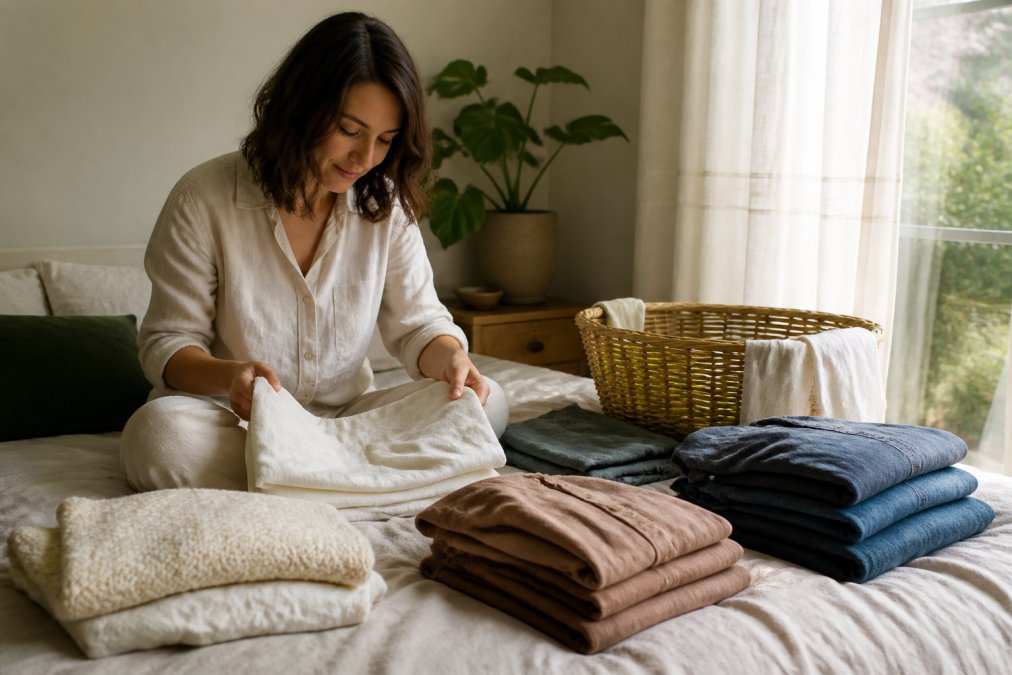
A common mistake is treating natural fibres like activewear. Hot water and a long cycle cause fibre relaxation and shrinkage, and they strip the natural shine from linen. The Australian Competition and Consumer Commission guidance on clothing care labelling confirms that care labels are legally required to reflect the recommended washing method, so read them before you improvise.
How to Prevent Shrinkage in Cotton Clothes
Shrinkage in cotton comes from heat and agitation, so remove both: wash cold on a gentle cycle, then air dry flat or on a line rather than in a tumble dryer.
Cotton fibres relax and contract under high temperatures, which is why a favourite tee can lose a size after one hot wash. Cold water keeps the fibre structure stable, and line drying removes the tumbling that pulls fibres tighter. If you must use a dryer, choose the lowest heat and remove the garment while still damp.
For cotton and cotton-blend pieces, these habits make the biggest difference:
- Wash at 30°C or cooler, never above 40°C
- Avoid long wash cycles that keep fibres agitated
- Skip the spin cycle on its highest setting
- Dry flat for knits, on a hanger for wovens
- Stretch gently back into shape while damp
Shrinkage prevention is about consistency: a garment washed cold every time holds its size far better than one that alternates between cold and hot cycles.
How to Remove Stains from Linen
Linen stains respond best to prompt, gentle treatment with cold water and a mild detergent. Blot the stain, flush it from the underside with cold water, then work in a small amount of detergent before washing as normal.
Linen is a strong cellulose fibre but vulnerable to harsh treatment. Never rub vigorously or use chlorine bleach on coloured linen. For protein-based stains such as dairy or blood, cold water is essential because hot water sets them. For oil-based stains, a drop of dishwashing liquid worked in gently usually lifts the mark.
A vinegar soak helps with odour and residue: add half a cup of white vinegar to a basin of cool water, soak for 20 to 30 minutes, then wash as usual. It also removes detergent residue that dulls the fabric.
For tougher marks, treat by type:
- Grease: dishwashing liquid, then a cool wash
- Protein stains: cold water flush, then enzyme-free detergent
- Ink: isopropyl alcohol on a cotton bud, blotted not rubbed
- Mildew: vinegar soak, then sun for a short period
Choice's guide to laundry detergents and stain removal is a useful independent reference for which products actually perform on common household stains.
The Best Eco-Friendly Laundry Detergent in Australia
The best eco-friendly laundry detergent for natural fibres is a mild, pH neutral, enzyme-free formula that rinses clean. Look for concentrated liquids or strips with a full ingredient list and no optical brighteners, which coat cellulose fibres and reduce their natural shine.
Detergent choice matters more than most people expect. Supermarket detergents often contain enzymes, brighteners and fillers designed for synthetics; on linen, hemp and cotton those additives leave residue that stiffens the fibre and traps odour. A pH neutral detergent protects fibre integrity and keeps breathable fabric breathable.
When comparing options, check for these markers:
- pH neutral or mildly alkaline
- Enzyme-free for wool and silk
- No optical brighteners
- Concentrated, so less packaging and fewer rinses
- Greywater and septic safe where relevant
If you sew your own pieces, The Spotted Quoll stocks natural fibre fabric by the metre, including washed 100% linen at $12.00 per metre and pure organic linen at $19.50 per metre, so you can match your detergent to the exact fibre you are working with.
Repair and Mending: Make Your Natural Fibre Clothes Last
Mending is the single most effective way to extend the life of natural fibre clothing. A small repair done early prevents a small hole from becoming a replacement purchase, and natural fibres take a darn or patch beautifully because they hold stitches well. The technique differs by fibre.

The first rule is to match the repair to the fibre. Cellulose fibres such as cotton, linen and hemp are strong and forgiving, tolerating a woven darn, visible patch or machine zigzag. Protein fibres such as wool and silk are more delicate, needing fine thread, a light touch and a repair that moves with the fabric. A heavy cotton thread on fine merino will saw through the surrounding fibres over time.
A basic mending kit costs very little and covers the repairs that matter most:
- Needles in a range of sizes, including a fine sharp for silk and a blunt tapestry needle for wool
- Thread matched to your main garment colours, plus a spool of fine silk or polyester thread for protein fibres
- A small patch of cotton or linen offcut for cellulose repairs, and a piece of lightweight wool or jersey for knits
- Sharp scissors, a thimble and a small embroidery hoop to hold tension
- A darning mushroom or a smooth rounded object to stretch knitwear over while you work
For holes in knitwear, a woven darn blends in. Work on the wrong side over a darning mushroom, lay a grid of warp threads across the hole, then weave weft threads over and under until filled. Keep tension slightly looser than the surrounding knit so it does not pucker. For split seams, an invisible ladder stitch closes the gap. For worn elbows or knees, cut an internal patch slightly larger than the worn zone, tack it inside, then stitch around the perimeter through the outer fabric only.
Fibre-specific repair notes make the difference between a fix that lasts and one that fails in a month:
- Cotton and linen: use a woven darn or a machine zigzag for stress points such as pocket corners and crotch seams. These fibres hold a stitch well and can take a slightly denser repair.
- Wool: avoid backstitching across a hole, which creates a hard ridge that rubs. Use a woven darn or Swiss darning that follows the knit structure, and use woolly nylon or matching wool thread so the repair flexes.
- Silk: use the finest needle you have, a single strand of silk thread, and a small running stitch. Silk shows every puncture, so keep stitches tiny and work from the wrong side where possible.
- Hemp: like linen, it is strong and abrasion-resistant, so it takes a robust patch. Pre-wash any patch fabric to avoid differential shrinkage.
People often attempt a repair, find it looks obvious, and give up. The fix is usually tension and thread weight, not technique: a lumpy darn means the thread is too thick or tension too tight, while a repair that pulls away means the patch was too small or the fabric too worn to hold stitches.
Wash and dry repairs gently, and they will outlast the surrounding fabric. Turn the garment inside out, use a mesh bag for small items, and avoid the tumble dryer, which undoes a careful darn fast.
The Australian Fashion Council's circular economy resources outline how repair and resale fit into a more sustainable wardrobe, and the same logic applies at home: every repair you complete is one less garment in the waste stream.
Do not use a hot iron directly on a fresh darn. Press lightly with steam from the wrong side, or the repair will flatten and the surrounding knit will lose its loft.
Hard Water Management for Natural Fibre Care
Hard water leaves mineral deposits in natural fibres, making them feel stiff and dulling colour over time. The fix is to soften the wash water or add a chelating agent, and to reduce detergent dose so residue does not compound the problem.
Hard water is common across much of the country and is one of the most overlooked causes of rough-feeling linen and cotton. Calcium and magnesium bind to detergent and to the fibre itself, leaving a chalky film: white streaks on dark garments, or towels that feel scratchy even when clean.
Manage it with a few simple adjustments:
- Reduce detergent to the minimum effective dose
- Add half a cup of white vinegar to the rinse cycle
- Use a laundry water softener or washing soda
- Run a monthly hot maintenance wash on the machine itself
- Dry in shade to avoid baking minerals into the fibre
If your water is very hard, a whole-house softener is the most effective long-term answer, though a significant investment. For most households, a vinegar rinse and a water softener additive keep natural fibres soft.
Pilling Prevention: Keep Your Natural Fibres Smooth
Pilling happens when short fibres work loose and tangle into small balls on the surface. The best prevention is to reduce friction, wash garments inside out, and rest high-wear areas between wears.
Pilling is a three-stage process: abrasion pulls short fibres to the surface, they tangle into a pill, and the pill either breaks off or stays anchored by longer fibres. Natural fibres pill less than many synthetics because their staple length is longer, but cotton knits, wool blends and loosely spun yarn can still pill under the arms, along hems and where bags rub.
Fibre length is the single biggest predictor. Long-staple cotton such as Supima or Egyptian pills far less than short-staple, and worsted wool less than woollen-spun. If a garment pills heavily in the first few wears, the cause is usually a short-staple fibre or loose spin, not your laundry routine.
Friction is the controllable cause, so anything that reduces rubbing helps:
- Wash knitwear inside out in a garment bag
- Avoid washing with heavy items such as jeans, towels or items with zips and hooks
- Use the delicate cycle and a low spin
- Rest garments between wears to let fibres recover
- Remove pills with a shaver or comb, never by hand
On tools, the choice matters. A fabric shaver with a fine mesh guard removes pills cleanly without cutting into the knit, and a sweater or cashmere comb lifts pills without pulling loops. A pumice stone or razor blade is a last resort and easily damages fabric. Work on a flat surface, use light pressure, and stop before the surface looks thin.
Static reduction also helps: natural fibres carry less static than synthetics, which is one reason they stay smoother and collect less lint. Adding half a cup of white vinegar to the rinse cycle reduces static and softens the fibre at once.
A practical knitwear routine: inspect under the arms and along the hem every second or third wear, de-pill lightly with a comb, and fold rather than hang. Hanging stretches shoulders and creates the friction points where pills form.
Conclusion: Care for Your Clothes, Care for the Planet
Caring for natural fibres well is one of the simplest ways to reduce what you throw away. Every extra year of wear from a cotton shirt or linen dress is a year of production, water and transport you did not need to repeat.

At The Spotted Quoll, we design and make natural fibre pieces in Tasmania precisely so they can be worn for years, not seasons. Our natural fibre face masks at $22.50 are washable, reusable and built to last. Our collections use natural fibres, exclusive nature-inspired prints and transeasonal capsule designs.
Get started with The Spotted Quoll and build a wardrobe that is kind to you and to the earth.
Frequently Asked Questions
How often should you wash natural fibre clothing?
Natural fibres like linen and hemp are breathable and resist odours, so you can wear them multiple times between washes. Air them out after wearing and spot-clean small marks. Wash when visibly soiled or after several wears. Over-washing breaks down fibres and shortens garment life, so wash less and air more.
Can you tumble dry natural fibre garments?
Tumble drying is risky for natural fibres. High heat causes shrinkage in cotton and weakens linen. If you must use a dryer, choose the lowest heat setting and remove items while slightly damp. Air drying is safer: lay knits flat and hang woven pieces. This preserves fibre integrity and prevents unnecessary wear.
Does organic cotton shrink after washing?
Yes, organic cotton can shrink, especially in hot water or high heat drying. To prevent shrinkage in cotton clothes, wash in cold water on a gentle cycle and air dry. Some shrinkage may still occur on the first wash, but following these steps minimises it. Always check the care label for specific instructions.
What is the best way to remove stains from linen?
Treat stains promptly. For most stains, flush with cold water and apply a mild detergent or a paste of bicarbonate of soda and water. For grease, sprinkle with cornflour to absorb oil before washing. Avoid hot water, which can set stains. For tough stains, soak in oxygen bleach (not chlorine) before washing as usual.