Table of Contents
- Why Fabric Quality and Sustainability Go Hand in Hand
- The Benefits of Natural Fiber Clothing: Breathability, Durability and Comfort
- Ethical Fashion Certifications Australia: What to Look For on a Label
- How to Assess Fabric Weight, Weave and Construction in Person
- How to Care for Linen Garments So They Last for Years
- Where to Source High Quality Sustainable Fabrics by the Metre
- Frequently Asked Questions
Last Updated: September 19, 2026
Why Fabric Quality and Sustainability Go Hand in Hand
Identifying high quality sustainable fabrics starts with one truth: a garment that falls apart after a few washes is not sustainable, no matter what the label claims. At The Spotted Quoll, we design and make clothing from natural fibres in our Tasmanian studio, where durability and ethics are the same conversation. A fabric that lasts for years uses fewer resources than three cheap replacements, so fibre choice, construction and care all matter together.
The Benefits of Natural Fiber Clothing: Breathability, Durability and Comfort
Natural fibre clothing offers breathability, comfort and durability that synthetics struggle to match. Linen, organic cotton and hemp regulate temperature, soften with age and biodegrade at end of life.
Here is what makes them different:
- Breathability: natural fibres let air move, so you stay cooler in heat and warmer in cold
- Durability: linen and hemp get stronger with washing, not weaker
- Comfort: they feel soft against skin and resist odour build-up
- End of life: natural fibres break down, unlike most synthetics
Natural vs Synthetic: What the Fibre Content Label Tells You
The fibre content label is your first quality check, listing what the fabric is made from by percentage. Look for a single natural fibre at a high percentage, like "100% linen" or "100% organic cotton." Blends are not automatically bad, but a small amount of natural fibre mixed into mostly polyester gives you the worst of both worlds.

Ethical Fashion Certifications Australia: What to Look For on a Label
Certifications verify a sustainability claim instead of asking you to trust it, but a logo on a swing tag proves nothing on its own. What matters is the scope of the certification, who in the supply chain holds it, and whether it covers the specific claim. A GOTS logo on a garment label means the finished product meets the standard; a GOTS logo on a website next to an uncertified fabric means nothing.
- GOTS (Global Organic Textile Standard): covers organic fibre content (minimum 70% organic for the "made with organic" grade, 95% for the "organic" grade), plus chemical inputs, wastewater treatment and social criteria across processing. It is a chain-of-custody standard, so certification travels with the fibre from farm to finished product.
- OEKO-TEX Standard 100: tests the finished fabric or garment for harmful substances such as formaldehyde, heavy metals and certain azo dyes. It says nothing about organic content, worker conditions or production impact, it is a chemical safety standard only.
- Fair Trade certification: verifies fair wages, safe conditions and no child labour at the certified operation. It is usually held by a co-operative or factory, not the brand, so check which entity holds it.
- B Corp: verifies a company's overall social and environmental performance. It is company-level, not fabric-level, so a B Corp brand can still sell a polyester blend.
- Responsible Wool Standard (RWS): verifies animal welfare and land management practices on wool farms, and traces the wool through the supply chain.
- Global Recycled Standard (GRS): verifies recycled content in a product and traces it through production, with additional social and environmental criteria.
Spotting Greenwashing: Claims That Mean Nothing Without Proof
Greenwashing is when a brand sounds sustainable without proving it. Vague words like "eco-friendly," "natural," "green" and "conscious" mean nothing on their own because they have no agreed definition or verification requirement. A real claim is specific and checkable: a named certification with a certificate number, a fibre percentage, a named factory or farm, or a traceable supply chain.
- Is the claim specific? "Made with organic cotton" is vague. "95% GOTS-certified organic cotton, certificate number X" is specific.
- Does the certification cover the claim? OEKO-TEX does not prove organic content, and B Corp does not prove a fabric is recycled. Match the certification to the claim.
- Who holds the certificate? A brand claiming GOTS on a fabric should name the mill or supplier that holds it.
- Can you check it? Search the certifier's public database for the certificate number. If it is not there, the claim is unverified.
- Is the language doing the work? Words like "planet-friendly," "eco-conscious" and "sustainable collection" are marketing, not standards, and are unregulated in Australia.
How to Verify a Supplier Claim Before You Buy
If you are buying fabric by the metre or sourcing for a small label, ask suppliers directly. Most reputable mills and wholesalers will answer these questions:

- Which certification does this fabric hold, and what is the certificate number?
- Which mill or farm is the fibre sourced from?
- What is the exact fibre composition by percentage?
- Is the certification on the fabric itself, or only on the raw fibre?
How to Assess Fabric Weight, Weave and Construction in Person
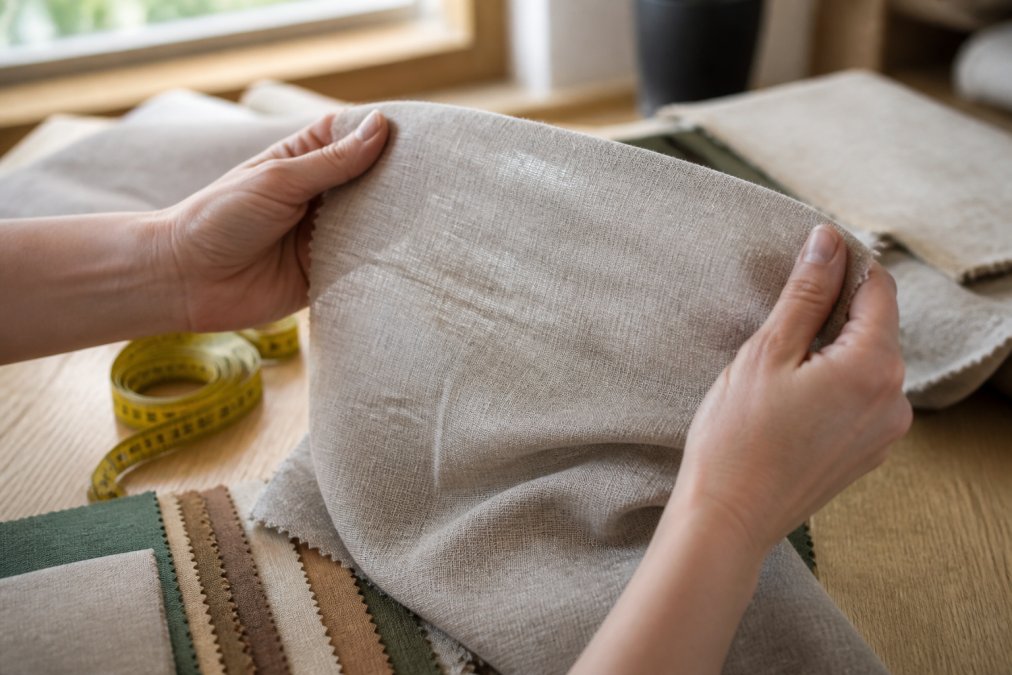
You can judge fabric quality with your hands in under a minute, but the checks only mean something if you know what you are measuring. Weight, weave and construction tell you how a garment will wear, drape and last, the three things a fibre content label never tells you.
Weight: Grams per Square Metre (gsm)
Fabric weight is measured in grams per square metre (gsm), the single most useful number on a fabric spec sheet. Most suppliers will give it to you if you ask.
As a rough guide:
- Under 120gsm: lightweight, shirtings, linings, summer dresses. Can be durable if the weave is tight, but prone to wear at stress points.
- 120-200gsm: mid-weight, the workhorse range for pants, dresses, tops and children's wear. This is where most everyday garments sit.
- 200-300gsm: heavyweight, outerwear, upholstery, structured garments. More durable but slower to drape.
- Over 300gsm: very heavy, coatings, bags, heavy homewares.
Weave: How the Threads Interlock
Weave is the pattern in which warp (lengthwise) and weft (crosswise) threads cross, and it determines strength, drape, breathability and how the fabric ages.
- Plain weave: one thread over, one under. Tight, stable, resists fraying. Poplin, broadcloth and most shirtings are plain weave. Good for durability and a crisp hand.
- Twill weave: diagonal pattern created by passing the weft over two or more warp threads. Denser and stronger than plain weave, with more drape. Denim and gabardine are twills.
- Satin weave: floats threads over several others, creating a smooth, lustrous face. Beautiful drape but more prone to snagging because the floats are exposed.
- Knit: loops rather than woven threads. Stretches, recovers and drapes softly. Jersey, rib and interlock are knits. Knits are comfortable but can pill and lose shape if the yarn is short-staple or the knit is loose.
Construction: The Details That Fail First
Fibre and weave get the attention, but construction is where most garments fail. Check these before you buy:
- Hold it to the light. A tight, even weave blocks light; a loose one looks see-through and thin. Uneven gaps mean an inconsistent weave that will wear unevenly.
- Stretch it gently. Good fabric springs back; weak fabric stays stretched or feels flimsy. This tests yarn quality and knit recovery.
- Scrunch and release. Quality linen and cotton recover with only soft creasing. Cheap blends stay creased and limp, signalling short-staple fibre or too much synthetic content.
- Check the seams. Look for neat, tight stitching, finished edges and no loose threads. French and flat-felled seams are stronger and hide raw edges. Poor seams fail first, long before the fabric does.
- Check the grain. Hold the fabric up and look along the selvedge. If the weave runs diagonally rather than straight, it has been cut off-grain and the garment will twist in the wash.
- Rub the surface. A light rub with your thumb reveals whether the fabric pills or sheds fibres. Some shedding is normal for natural fibres; heavy pilling on a new fabric is not.
If you are buying online and cannot touch the fabric, ask the supplier for the gsm, the weave type and the fibre composition by percentage. A supplier who can answer all three is usually one who knows their product. A supplier who cannot is a risk.
How to Care for Linen Garments So They Last for Years
Linen gets better with age if you care for it correctly: wash cold, skip the dryer and air dry to protect the fibres.
Follow these rules:
- Cold, gentle machine wash in a laundry bag
- Use a phosphate-free detergent
- Reduce the spin cycle
- Never tumble dry
- Hang inside out to prevent fading
- Iron with warm steam while slightly damp
Where to Source High Quality Sustainable Fabrics by the Metre
Sourcing fabric by the metre lets you check quality yourself and make pieces that last. Buy from suppliers who name the fibre, weight and certification for every fabric.
| Fabric | Weight | Width | Best For |
|---|---|---|---|
| Pure Organic Linen | 190gsm | 145cm | Homewares, dresses, all seasons |
| Washed Linen | 165-183gsm | 135cm | Pants, frocks, bags |
| Organic Cotton Poplin | Light-mid | 138cm | Shirts, tops, summer dresses |
| Organic Cotton Jersey | 180gsm | 150cm | Tees, dresses, children's wear |
Frequently Asked Questions
How can you tell if a fabric is high quality?
Check the fibre content label first. Natural fibres like linen, organic cotton and hemp are a strong starting point. Then look at weight and weave: a mid-weight linen at 165-190gsm holds its shape better than a thin, loose weave. Hold the fabric up to light to check density, and feel for a tight, even weave. Certified organic or eco-labels add another layer of confidence about how the fibre was grown and processed.
What certifications should I look for on sustainable clothing labels?
Look for recognised textile certifications such as Global Organic Textile Standard (GOTS), OEKO-TEX Standard 100, and Fair Trade certification. These certifications verify different things: organic fibre content, chemical safety, or fair labour practices. A label that names a specific certification and shows the logo is far more trustworthy than vague phrases like 'eco-friendly' or 'natural'.
What are the most sustainable natural fabrics to look for?
Linen, organic cotton, hemp and Tencel (lyocell) are among the strongest options. Linen from flax requires less water than conventional cotton and is biodegradable. Organic cotton avoids synthetic pesticides. Hemp grows quickly with minimal inputs.
Why does fabric weight and weave matter for garment longevity?
Heavier, tighter weaves resist pilling, tearing and stretching better than loose, lightweight fabrics. A 190gsm linen will outlast a 120gsm one in regular wear. Weave structure also affects breathability and drape. When shopping in person, stretch the fabric gently: if it distorts easily and doesn't spring back, it will likely lose shape after a few washes. Fabric construction is one of the most reliable indicators of how long a garment will last.
The real challenge is not finding sustainable fabrics; it is finding ones you can trust and that will last. The Spotted Quoll makes that easier with natural-fibre fabrics and timeless, small-batch designs made in our Tasmanian studio. Browse our fabric range by the metre, or explore our transeasonal capsule wardrobe pieces built to serve you for years. Get started with The Spotted Quoll and build a wardrobe that is kind to you and the earth.