Table of Contents
- Why Ethical Clothing Manufacturing in Tasmania Matters
- Ethical Clothing Accreditation Australia: What Actually Counts
- Benefits of Local Textile Manufacturing for Australian Brands
- How to Identify Ethical Fashion Brands Without Getting Greenwashed
- What Ethical Clothing Manufacturing in Tasmania Looks Like in Practice
- The Cost of Ethical Manufacturing: What Startups and Boutiques Need to Know
- Conclusion
- Frequently Asked Questions
Last Updated: September 18, 2026
Why Ethical Clothing Manufacturing in Tasmania Matters
Ethical clothing manufacturing in Tasmania is a small, traceable production model where garments are cut, sewn and finished in local studios using natural fibres, with documented supply chains and fair pay for the makers involved. It matters because most fashion sold here is made offshore, where visibility over working conditions and environmental standards drops sharply.
This guide from The Spotted Quoll covers what ethical production actually looks like on the ground, how accreditation works, and how to tell a genuine local maker from a marketing story. The Spotted Quoll Studio designs and makes women's fashion from natural fibres in Tasmania, so the perspective here comes from inside a working studio rather than a directory listing.
Australia has no single mandatory "ethical" label for clothing. What exists is a patchwork of voluntary certification schemes, modern slavery reporting obligations for larger businesses, and consumer law that prohibits misleading claims. That patchwork is exactly why so much greenwashing survives.
Ethical Clothing Accreditation Australia: What Actually Counts
Ethical clothing accreditation in Australia is a voluntary certification or membership scheme that independently verifies labour conditions, environmental practices, or fibre sourcing. It is not government-issued, and no single scheme covers everything. Navigating these diverse frameworks requires a nuanced understanding of how ethical sourcing practices translate into tangible improvements across the global supply chain.
The schemes worth knowing fall into three rough groups, and it helps to name the actual ones rather than talk about categories in the abstract:
- Labour and factory audits. These verify fair wages, safe conditions and no forced labour at the cut-make-trim stage. The best-known international benchmark is SA8000, administered by Social Accountability International, which audits social performance at the factory level. Fair Wear Foundation membership is another route, though it is built around brands that commit to a code of labour practice and independent verification rather than certifying a single facility.
- Fibre and material certifications. These trace organic or recycled content back to source. The Global Organic Textile Standard (GOTS) covers the whole textile chain from organic fibre through processing, and is the certification most often cited on organic cotton and linen garments. The Global Recycled Standard (GRS) does the equivalent job for recycled content. The Responsible Wool Standard and the Responsible Mohair Standard cover animal welfare and land management for those fibres.
- Business membership and disclosure programs. These require public supply chain disclosure as a condition of joining.
The trap is treating any one of these as a complete ethical guarantee. A fabric can be GOTS-certified and still be sewn in a facility nobody has audited. A factory can pass a labour audit while its dyehouse discharges untreated water. Accreditation answers the specific question it was designed to answer, nothing more.

Two pieces of Australian regulation sit underneath all of this and are worth understanding because they are not optional:
- The Australian Consumer Law, enforced by the ACCC, prohibits misleading or deceptive conduct and false or misleading representations about goods, including environmental and ethical claims. A brand cannot say 'sweatshop free' or 'sustainably made' without a reasonable basis. The Australian Competition and Consumer Commission guidance on environmental and sustainability claims sets out what businesses can and cannot say, and it is worth reading before you trust any label.
- The Modern Slavery Act 2018 (Cth), which requires entities above the reporting threshold, currently $100 million consolidated revenue, to publish an annual modern slavery statement on the Australian Government's Modern Slavery Register. This is a reporting obligation, not a certification, and it does not apply to small studios. That is precisely why direct questions matter more at the small end of the market.
For a small studio, the practical proof points are simpler than a certificate wall: named makers, a stated location, visible fabric sourcing, and a willingness to answer direct questions about where each component comes from.
Benefits of Local Textile Manufacturing for Australian Brands
Local textile manufacturing shortens the supply chain, which makes traceability, quality control and restocking faster and more verifiable. For Australian brands, that translates into lower risk and stronger customer trust, not just a nicer story.
The benefits that actually show up in practice:
- Traceability. When cutting and sewing happen in the same building, you can answer "where was this made" without emailing three suppliers.
- Small-batch flexibility. Short runs let a brand test a print or a cut without committing to thousands of units.
- Fabric waste reduction. Offcuts from one garment can feed the next small run instead of being shipped offshore as waste.
- Faster restocking. A best-selling cut can be re-sewn locally in weeks rather than waiting on an overseas container.
Garment longevity is the quieter benefit.
The logistics angle most guides skip
The real Tasmanian advantage is what the island geography does to a supply chain.
Freedom Top Organic Cotton - Lost →
Raw material procurement. Tasmania has no large-scale commercial textile mill producing finished apparel fabric. Organic cotton and linen are imported from the mainland or overseas, which means a local maker still carries an inbound freight cost and a lead time on fabric before a single garment is cut. The ethical gain is not zero-freight sourcing; it is that the maker knows and can name the fabric supplier, and can hold stock locally rather than relying on a factory's inventory.
Freight to the mainland. Most of a Tasmanian maker's customers sit across Bass Strait. Goods move by sea freight via the Spirit of Tasmania or by air, and both add cost and transit time that a mainland studio does not carry. A brand selling into Melbourne or Sydney needs to build that into its fulfilment promise.
How to Identify Ethical Fashion Brands Without Getting Greenwashed
To identify an ethical fashion brand, look for specifics rather than sentiment: named factories or studios, stated fibre origins, and claims you can check. Vague language like "consciously crafted" or "planet-friendly" with no detail behind it is a warning sign.
A working checklist:
- Does the brand name where the garment was made, not just "designed in"?
- Can it tell you the fibre content and where the fabric came from?
- Are certification claims specific about which stage they cover?
- Does it publish any supply chain information at all?
- Do the prices make sense for the claims? Genuine local production rarely lands at fast-fashion prices.
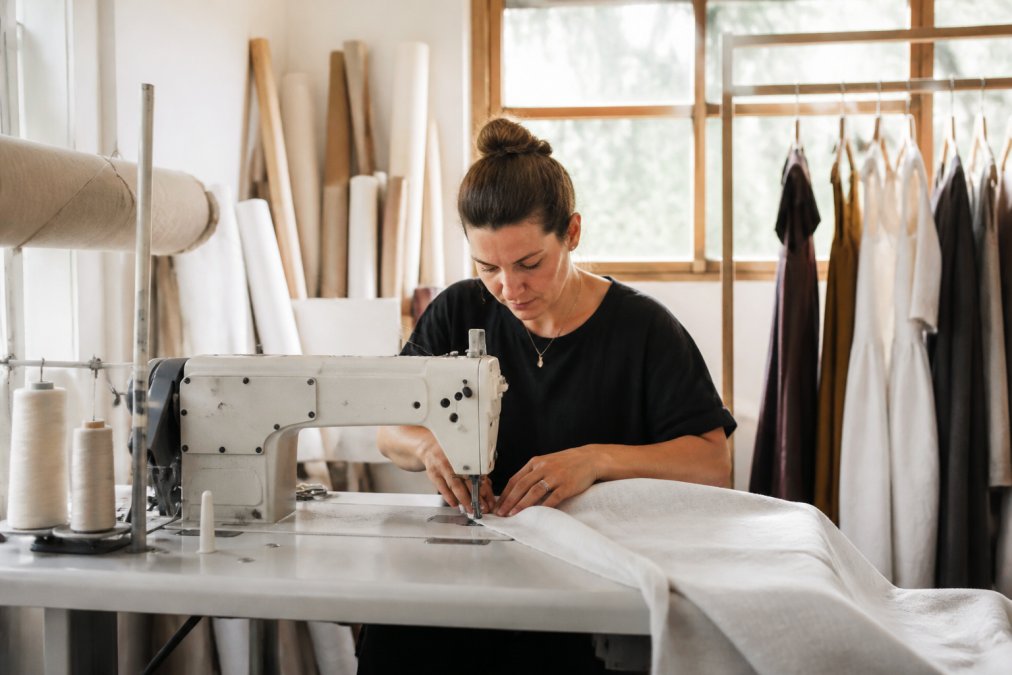
What Ethical Clothing Manufacturing in Tasmania Looks Like in Practice
The Cost of Ethical Manufacturing: What Startups and Boutiques Need to Know
Ethical manufacturing costs more per unit than offshore production, mainly because of local wages, smaller volumes and natural fibre prices. For startups and boutiques, the realistic approach is to start with a narrow range and price honestly rather than compete on volume.
Where the money goes:
| Cost factor | Why it rises | Practical impact |
|---|---|---|
| Local wages | Award rates apply, no offshore labour arbitrage | Higher per-unit cost, no hidden labour risk |
| Small batch runs | Setup cost spread over fewer units | Limited colourways and sizes per drop |
| Natural fibres | Organic linen and cotton cost more than synthetics | Higher fabric cost, better longevity |
| Local logistics | Short domestic freight, no container shipping | Faster restocking, lower freight risk |
| Certification and audits | Fees and admin time | Verifiable claims, slower onboarding |
Conclusion
The hard part of ethical clothing manufacturing is not finding a certification, it is verifying the specific claim behind the label. Narrow, checkable claims beat broad, sentimental ones every time.
Frequently Asked Questions
How does Ethical Clothing Australia accreditation actually work?
Ethical Clothing Australia accredits businesses that meet Australian workplace laws across their local supply chain, including fair wages, safe conditions and lawful hours. The process involves self-assessment, independent audit and ongoing compliance checks. Accreditation covers cut, make and trim operations, so it applies to brands manufacturing onshore rather than offshore. For shoppers, it is an Australian-specific marker that verifies ethical clothing manufacturing claims rather than relying on self-reported statements.
Why is local textile manufacturing considered more ethical than offshore production?
Local production keeps garment work inside Australian workplace law, which sets minimum wages, safety standards and conditions that are enforceable. It also shortens the supply chain, so traceability is easier to verify and the carbon footprint from freight is lower. Small-batch runs reduce overproduction and textile waste, and money spent stays in the local economy. That does not automatically make every local brand ethical, but it removes several of the biggest risks that come with long, opaque offshore supply chains.
How can I verify if a clothing brand is ethically accredited in Australia?
Check the Ethical Clothing Australia accredited brands list directly rather than trusting a logo on a website. Look for named factories or studios, specific fibre details such as super-fine merino wool or organic linen, and clear statements about where cutting, sewing and finishing happen. If a brand cannot say where its garments are made or who makes them, treat sustainability claims with caution.
What does ethical clothing manufacturing in Tasmania look like day to day?
In practice it means small studios where patterns are graded, fabric is cut and garments are sewn by local makers under Australian workplace conditions. Runs are short, often limited to specific prints or dye lots, which reduces textile waste and overproduction. Natural fibres such as organic cotton and organic linen are common because they suit small-batch knitwear and garment construction. Studios like The Spotted Quoll design and make in Tasmania, which keeps traceability, fair wages and environmental standards visible rather than hidden behind offshore contracting.