Table of Contents
- Why Australian Retailers Are Switching to Sustainable Fashion Wholesale
- What Defines Sustainable Fashion Wholesale in Australia
- How to Verify Ethical Clothing Australia Accreditation
- Vetting Suppliers: A Step-by-Step Checklist
- The Cost-Benefit Case for Sustainable Stock
- How to Start a Sustainable Clothing Boutique: Sourcing Natural Fibre Wholesale Clothing
- Build Your Capsule with The Spotted Quoll
- Conclusion: Make Your Next Order Count
- Frequently Asked Questions
Last Updated: September 6, 2026
Why Australian Retailers Are Switching to Sustainable Fashion Wholesale
The shift toward sustainable fashion wholesale australia is no longer a niche preference; it is becoming a core expectation for the modern retail customer. Shoppers are increasingly scrutinising where their garments come from, demanding transparency that fast fashion simply cannot provide.
Buyers now ask pointed questions about fabric origins, factory conditions, and the brand's overall environmental footprint. Retailers who answer with verifiable proof, rather than vague marketing claims, secure a dedicated following.
This guide covers the practical side of sourcing sustainable fashion wholesale in Australia: what defines an ethical supplier, how to verify accreditations, and the financial logic behind investing in quality over quantity.
What Defines Sustainable Fashion Wholesale in Australia
Australian sustainable fashion wholesale is defined by a commitment to traceability, from the farm where the fibre grows to the warehouse where the stock lands. It rejects the opaque, globalised supply chains of fast fashion in favour of local production and verifiable standards.
In the Australian context, the definition is increasingly shaped by two forces most consumer-facing guides ignore: the regulatory push for supply chain transparency, and the practical shift toward circular business models that reduce waste at the wholesale level.
The Regulatory Baseline: Modern Slavery and Product Stewardship
Since 2019, the Modern Slavery Act 2018 (Cth) has required entities with consolidated revenue above $100 million to report annually on modern slavery risks. While this threshold does not directly bind most independent boutiques, it has a trickle-down effect: large retailers and wholesalers now demand documentation from their suppliers, including smaller Australian makers. Asking your supplier whether they have completed a modern slavery statement, even if not legally required, is a practical way to gauge whether they treat compliance as a burden or a baseline.
A second regulatory signal is product stewardship for textiles. The federal government's National Waste Policy Action Plan targets halving organic material sent to landfill by 2030, with textiles squarely in scope. While no mandatory textile EPR scheme is yet in force, state-based initiatives and industry pilots are underway. A supplier that designs for recyclability, offers take-back programs, or documents its end-of-life strategy is positioning itself ahead of a regulatory curve that will likely tighten.
Circular Fashion and Waste Reduction at the Wholesale Level
Circular fashion has concrete implications for how you buy wholesale. It means choosing suppliers who design for durability, repairability, and eventual recyclability, and who are transparent about what happens to their own production offcuts.
Ask potential suppliers three questions that most boutique owners never think to raise:
- What happens to your fabric offcuts? A maker who composts or recycles offcuts is operating with a genuine circular mindset.
- Do you offer a repair service or spare buttons and thread? This extends the usable life of the garment.
- Can you take back unsold wholesale stock at end of season? Some ethical manufacturers offer buy-back or consignment arrangements, preventing deadstock from being landfilled.
Natural Fibres vs Synthetic Fabrics
The fabric choice is the single biggest determinant of a garment's environmental impact. Natural fibres like organic cotton, bamboo fibre, and linen are biodegradable and require significantly less energy to produce than petroleum-based synthetics. Organic cotton avoids the heavy pesticide use of conventional farming, supporting better soil health and biodiversity.
Synthetics such as polyester shed microplastics into waterways with every wash and take centuries to break down in landfill (peer-reviewed research). While recycled synthetics are an improvement, they do not solve the fundamental issue of textile waste.
Ethical Manufacturing Standards
Beyond the fabric, ethical manufacturing covers the human element of production: safe working conditions, fair wages, and reasonable hours. In Australia, the most recognised benchmark is the Ethical Clothing Australia accreditation, which audits the entire local supply chain from textile workers to cutters and machinists (ethicalclothingaustralia.org.au).
Look for suppliers who openly discuss their production partners and factory locations. A brand that manufactures locally, like The Spotted Quoll which designs and makes everything in Tasmania, offers a level of oversight that offshore production simply cannot match. This local production model shortens the supply chain, reduces transport emissions, and supports the domestic economy.
How to Verify Ethical Clothing Australia Accreditation
Verifying ethical clothing australia accreditation is a straightforward process that protects your boutique from greenwashing. This rigorous, third-party audited certification ensures every stage of a garment's local production meets Australian workplace laws.
Start by checking the official Ethical Clothing Australia website, which maintains a public register of accredited businesses. Cross-reference the supplier's name and look for their specific accreditation number. A legitimate business will display this proudly and be happy to discuss the details of their audit.
If a supplier claims to be ethical but lacks this accreditation, ask them directly why. They may rely on other international certifications like GOTS certified for organic textiles or OEKO-TEX for product safety. While these are valid, they do not cover the Australian workplace relations standards that Ethical Clothing Australia enforces, so treat them as complementary, not equivalent.
Vetting Suppliers: A Step-by-Step Checklist
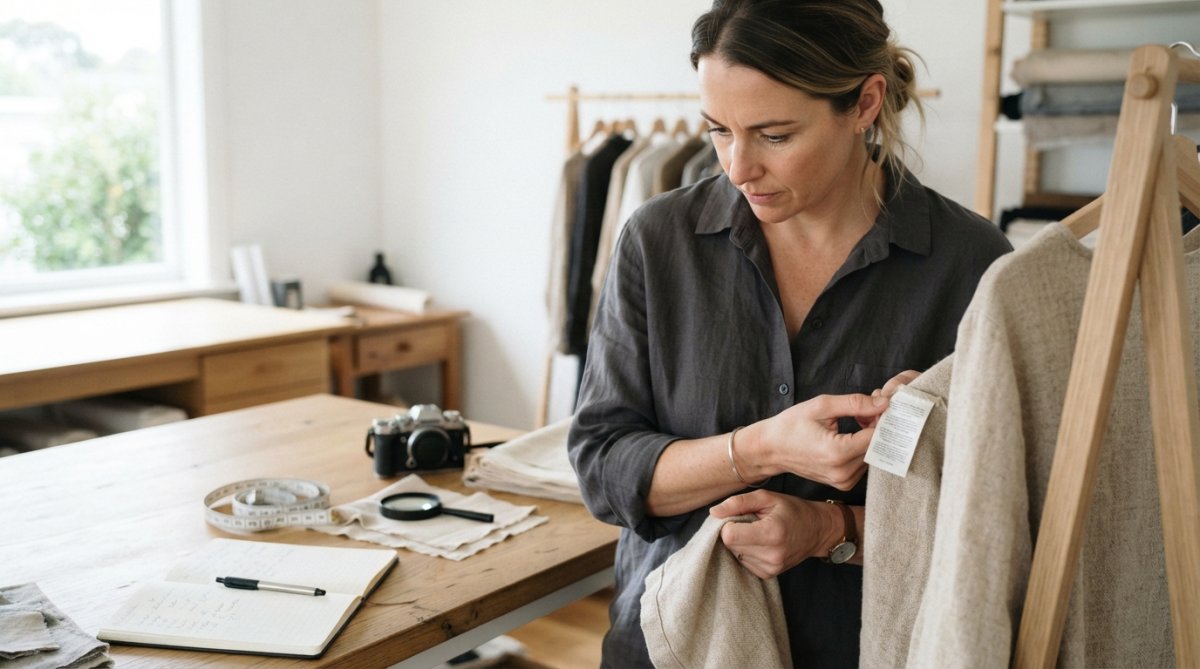
A structured vetting process separates genuine sustainable fashion wholesale partners from those merely trading on the trend. Use this checklist to evaluate every potential supplier before committing to a wholesale order.
- Check Accreditation: Confirm the supplier holds current Ethical Clothing Australia accreditation or an equivalent verifiable standard.
- Trace the Fibres: Ask for proof of fibre origin. Is the organic cotton GOTS certified?
- Audit the Manufacturing: Where is the garment made? Can the supplier provide details on the factory, its working conditions, and its social compliance record?
- Review the Dyes and Materials: Request documentation on low-impact dyes and confirm no hazardous chemicals are used.
- Assess Packaging: Does the supplier use plastic-free packaging for their wholesale shipments?
- Evaluate Durability: Order a sample to test the fabric's quality. A sustainable garment should withstand repeated washes and wear without losing its shape or colour.
The Cost-Benefit Case for Sustainable Stock
The most common objection to sustainable fashion wholesale is the higher upfront cost compared to fast fashion. This is a short-sighted view that ignores the true economics of retail, which change dramatically when you factor in quality, customer lifetime value, and the risk of being associated with unethical production.
To make this case convincingly, you need more than a vague sense that 'customers care'. Here is a practical, data-informed framework tailored to the Australian retail market.
The Real Price Gap: What You Are Paying For
Sustainable garments command a higher retail price because they cost more to make correctly. You are paying for organic materials, fair wages, and ethical auditing, all of which add to the base cost. That gap reflects the cost of Australian wages under the Fair Work Act 2009 (Cth), the expense of GOTS-certified fibre, and the overhead of third-party audits.
The key is not to compete on price per unit, but on price per wear. A $150 wholesale organic cotton dress that lasts 100 wears costs $1.50 per wear (moneysmart.gov.au). A $50 fast fashion dress that falls apart after 10 wears costs $5.00 per wear. The sustainable option is three times cheaper for the customer over the garment's life, and far less likely to be returned or refunded.
Consumer Willingness to Pay: What Australian Data Shows
Australian consumers' spending patterns reflect their stated preferences.
For a boutique, this translates into a clear pricing strategy. You can position sustainable stock at a premium over conventional equivalents without losing customers, provided you can substantiate the claim with accreditation and traceability. The risk is not the premium; it is the unverified claim that invites scepticism.
The Hidden Cost of Fast Fashion: Returns, Deadstock, and Reputation
Fast fashion's low unit cost conceals several liabilities that eat into margin:
- Higher return rates. Poorly constructed garments fail faster, leading to more refunds and exchanges.
- Deadstock risk. Trend-driven fast fashion becomes unsellable within a season. Sustainable, transeasonal staples hold value across multiple seasons, reducing markdown exposure.
- Reputational risk. A single exposé about a supplier's labour practices can permanently damage a boutique's brand. The Modern Slavery Act 2018 (Cth) has heightened media and consumer scrutiny on supply chains. Stocking unverified 'ethical' brands leaves you exposed to accusations of greenwashing, a risk with no insurance premium.
A Simple ROI Framework for Your Buying Decision
Before placing a wholesale order, run this five-point check:
- Gross margin: Can you achieve a minimum 2.5x markup (cost price to retail) on the sustainable item? If not, does the higher expected sell-through rate compensate?
- Customer lifetime value: Will this item bring customers back? Sustainable basics have higher repeat purchase rates.
- Return rate estimate:
- Markdown risk:
- Brand equity: What is the marketing value of being able to say '100% Australian-made, certified organic'? For most boutiques, this differentiator is worth more than the margin difference.
How to Start a Sustainable Clothing Boutique: Sourcing Natural Fibre Wholesale Clothing
Learning how to start a sustainable clothing boutique involves mastering the art of sourcing natural fibre wholesale clothing that aligns with your brand story. Your product mix is your identity, so every piece must reflect the values of sustainability and quality you promise your customers.
Focus on building a cohesive range around transeasonal staples. A capsule collection of versatile dresses, pants, and tops in organic cotton and linen can serve customers across multiple seasons, reducing your risk of deadstock. Prioritise natural fibres that offer comfort and durability, and choose exclusive prints or design elements that differentiate your store from high street offerings.
Minimum Order Quantities and Lead Times
Understanding minimum order quantities (MOQs) and lead times is critical for managing your cash flow. Many small-batch producers, like The Spotted Quoll, operate with lower MOQs than mass manufacturers, making them accessible to independent boutiques. This flexibility allows you to test new styles without overcommitting your budget.
Lead times for ethically made, small-batch production are naturally longer than mass-produced fast fashion. Factories that treat their workers fairly do not rush orders. Expect a lead time of several weeks or even months for production and delivery. Plan your buying calendar accordingly and communicate these timelines clearly to your customers.
Logistics and Carbon Offsetting for Wholesalers
The environmental impact of your wholesale operation extends to shipping logistics. Transport emissions are a significant part of a product's carbon footprint. Mitigate this by consolidating orders and choosing sea freight over air freight whenever possible.
Carbon offsetting neutralises the emissions you cannot avoid; many logistics providers offer carbon-neutral shipping options. Consider partnering with suppliers who use plastic-free packaging and recycled materials. Every layer of your supply chain contributes to your store's overall environmental stewardship.
Build Your Capsule with The Spotted Quoll
For retailers seeking a reliable partner in sustainable fashion wholesale, The Spotted Quoll offers a compelling proposition rooted in genuine Australian craftsmanship. Our studio, one of the last remaining working studios in Australia, designs and produces every piece in Tasmania. This local production model provides full supply chain transparency, allowing you to tell your customers exactly where and how their clothes were made.
Our collections focus on natural fibres, including organic cotton and organic linen, crafted into transeasonal capsule wardrobe staples. We offer exclusive, nature-inspired prints that give your boutique a unique point of difference. Our wholesale program is designed for like-minded retailers, and we are happy to discuss MOQs and restocking timelines to suit your business needs.
A standout piece for any season is our Organic Denim Peasant Dress - Staple, priced at $298.00. This dress captures the laid-back Australian lifestyle with its inky organic denim and rusty gold top stitching, combining style with the ethical production your customers demand.

Conclusion: Make Your Next Order Count
Choosing sustainable fashion wholesale australia is a deliberate act that shapes your brand's future. It requires moving beyond price-based decisions to embrace a model built on quality, transparency, and respect for people and the planet.
The challenge is to resist the allure of fast fashion margins and commit to a slower, more thoughtful approach to retail. Your customers are ready for this shift, and they are seeking out businesses that offer genuine solutions. By partnering with an ethical, Australian-made brand, you position your boutique at the forefront of the circular economy movement.
Frequently Asked Questions
What is the minimum order quantity for sustainable fashion wholesale in Australia?
Minimum order quantities vary widely between wholesalers. Some Australian makers, like The Spotted Quoll, offer flexible MOQs for small boutiques, while larger manufacturers may require 50 to 100 pieces per style. Always ask about MOQs upfront, along with restock lead times. Smaller MOQs let you test new styles without overcommitting, which is useful when you are starting a sustainable clothing boutique.
How do I verify ethical accreditation for wholesale clothing suppliers?
Look for recognised certifications such as GOTS for organic fibres, OEKO-TEX for safe textiles, or the Ethical Clothing Australia accreditation, which audits local supply chains for fair work practices. Ask suppliers for their certification numbers and check them against the issuing body's registry. A genuine accreditation covers the entire production chain, not just the fabric. If a supplier cannot show documented proof, ask for a transparent breakdown of where and how their garments are made.
What is the difference between ethical and sustainable fashion in a wholesale context?
Ethical fashion focuses on people: fair wages, safe working conditions and worker rights throughout the supply chain. Sustainable fashion focuses on the planet: natural fibres, low-impact dyes, reducing textile waste and lowering carbon footprint. The best wholesale partners address both. For example, a dress made from certified organic cotton in a local workshop covers the environmental side and the ethical side. Ask suppliers how they handle both social compliance and environmental stewardship.
What are the benefits of stocking Australian-made sustainable fashion?
Stocking Australian-made sustainable fashion means shorter shipping distances, which cuts transport emissions and supports local manufacturing jobs. Local production also makes supply chain transparency easier to verify, and you can visit studios or meet makers in person. Restocking is often faster, helping you respond to demand without holding excess stock. Customers increasingly value traceability, and being able to tell a clear story about where a garment was made builds trust in your boutique.
Get started with The Spotted Quoll and build a wholesale range that reflects your commitment to ethical, natural fibre fashion. Explore our wholesale collections and bring exclusive, Tasmanian-made designs to your customers.